
The After-School Grind: Your First $100
Picture this: you just finished mowing Mrs. Johnson’s lawn. She hands you a crisp $40 bill. You stuff it in your pocket, promise to come back next week, and pedal home. By the time you get there, you’ve forgotten what day you agreed on. You can’t find her number. And that $40? It’s already mixed in with your other cash, destined to vanish on snacks and games. Your promising lawn care empire is now a disorganized, forgotten hustle.
This is how most teen side hustles die—not from lack of effort, but from invisible friction. You’re not competing with other teens; you’re competing against your own ability to stay organized without adult-level tools. The good news? Your age is your secret weapon. You can’t get a business loan at 16, so your tools need to be affordable and under your control from day one. Learning how to start a side hustle at 16 means building a system that works for you, not against you.
Why Your First Business Should Be Invisible (To Everyone Else)
Most advice for teen entrepreneurs is terrible. It tells you to build a social media following, create an LLC, or use complicated accounting software. That’s like being told to learn aerodynamics before fixing your bike chain. The real goal of your first side hustle isn’t to go viral—it’s to create a repeatable, manageable system that puts money in your pocket without taking over your life.
The core advantage you have is constraint. You don’t have a credit card for monthly subscriptions. You can’t sign binding service agreements. You probably shouldn’t be storing client data in some random free app’s cloud. These limitations force you to build a lean, efficient operation that actually makes money, instead of just looking like a business.
After researching dozens of business apps aimed at small operations, one pattern stands out: they’re all built for adults with business bank accounts and tax IDs. They assume you want to “scale” and “integrate.” For a teen tutoring three classmates or selling custom keychains, that’s overkill. What you need is simpler: a way to remember who owes you what, what you’ve spent, and what you’ve promised to deliver.

The Offline-First Toolbox: Own Your Data From Day One
Your client list and financial projections are your most valuable assets. Would you hand a physical notebook with all your customers’ phone numbers to a stranger and hope they give it back? Of course not. Yet, that’s exactly what happens when you use free “productivity” apps that harvest your data.
We believe business tools should work offline by default. Here’s why: your deals happen where Wi-Fi doesn’t. In a driveway discussing a car wash, at a soccer field arranging tutoring, in a cafeteria taking a lunch order. If your app needs a signal to log a new client or calculate a quote, you’ve already lost the moment.
Building a side hustle on free apps that track you is like constructing your castle on rented land. The following table breaks down the hidden costs of “free” versus the concrete value of owned, offline tools.
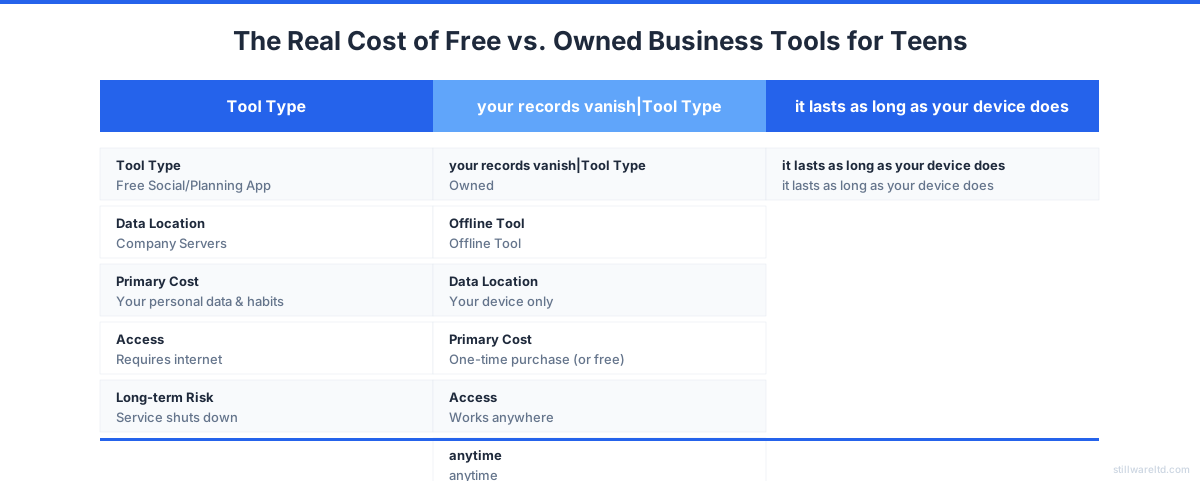
The right toolkit isn’t about fancy features. It’s about these core, offline-capable functions:
- Contact Memory: A simple place to log a client’s name, what they ordered, and how to reach them. No “cloud sync” needed—just your phone’s storage.
- Money Tracker: A basic ledger for money in (sales) and money out (supplies). This tells you if you’re actually making a profit on those bracelets.
- Professional Output: The ability to generate a clean, simple invoice as a PDF. You can text it, email it, or print it. It makes you look legitimate and helps avoid “I forgot to pay you” situations.
Most business apps share a troubling assumption: that your data is also their asset. For a teen’s side hustle, that’s a non-starter. Your customer list is small, personal, and confidential. It belongs on your device, period. For a deeper look at the specific tools that work offline for young entrepreneurs, see our guide to offline teen side hustle tools.
Your Step-by-Step Launch Plan (Next Weekend)
Forget year-long business plans. Let’s get you operational in days. This plan focuses on action, not theory.
- Pick Your Hustle (The 1-Hour Decision): List skills you already have. Babysitting, tech help for neighbors, graphic design for school clubs, baking, yard work. Choose one that requires under $20 in starting supplies. Don’t overthink it.
- Price It Right (The 5-Minute Math): For your first few jobs, charge enough to make it worth your time, but not so much that people hesitate. A good rule: materials cost + ($15-$20 per hour). For a service like tutoring, research what local tutors charge and halve it to start.
- Gather Your Tools (The Offline Kit): This is your operational backbone. Before you take a single job, have these ready:
- A dedicated notebook or a notes app that works offline.
- A simple calculator.
- A payment method: Cash is king, but know how to use Venmo/CashApp with a parent’s help if needed.
- (The Pro Move): A way to create a basic invoice. This could be a template on your computer or a simple app that saves PDFs directly to your phone.
- Secure Your First Client (The 3-Ask Method): Don’t shout into the void online. Be specific. Tell 3 people you know well: “I’m starting a [your hustle] service. Do you know anyone who might need help with that?” Your network is your best marketing.
- Execute & Document (The Ritual): Do the job well. Then, immediately: 1) Record the client’s details and what you did, 2) Give them an invoice (even if it’s just a handwritten note), 3) Log the income and any expenses. This 5-minute ritual is what separates a hobby from a business.
The average teen side hustle fails within 8 weeks, not from lack of demand, but from the silent drain of disorganization. The ones that last treat their first $50 job with the same seriousness as a $500 job.

The 5 Pitfalls Most Teen Hustlers Get Wrong
Watching hundreds of micro-businesses start and stall gives you a clear view of the common traps. Avoid these, and you’re already ahead.
- Over-Complicating the Brand: Spending 10 hours designing a logo before you’ve made your first sale. Your “brand” right now is your reliability and the quality of your work. A simple, clear text message is more valuable than a fancy Instagram theme.
- Using the Wrong Financial Metrics: Focusing on total revenue instead of profit. If you make $100 selling cookies but spent $45 on ingredients, your profit is $55. That’s the number that matters. Track profit, not just cash in hand.
- Ignoring Client Management: Treating every job as a one-off. Your goal is repeat business and referrals. If you don’t remember what Mrs. Johnson liked about your work or when she usually needs you, you’re leaving money on the table.
- Platform Dependency: Building your entire operation on a single social media platform or a free app that could change its rules tomorrow. If TikTok bans your account or a free planner app shuts down, your business shouldn’t disappear with it. Your core records should live independently.
- Scaler’s Disease: Immediately trying to hire friends or outsource parts of the job you haven’t mastered yourself. Do everything yourself first. You’ll understand the real costs, time, and value, which makes you a better manager later.

Building a System That Outlasts Your Motivation
Motivation is fleeting. A good system works even when you’re not feeling it. Your system is just a set of simple, non-negotiable habits.
Your Weekly Review (15 Minutes, Every Sunday):
- Check your money log. How much profit did you make this week?
- Look at your client list. Who haven’t you heard from in a while? Send a quick, non-spammy check-in text. (“Hey, just finished up a lawn service round. Your garden is looking great! Need a trim in the next few weeks?”)
- Plan the upcoming week. Block out 2-3 specific timeslots for hustle work.
- Check your supplies. Do you need to buy more materials before your next job?
This ritual turns reactive chaos into proactive control. The tools you choose should make this review easier, not harder. If an app requires an internet connection, has distracting notifications, or tries to upsell you every time you open it, it’s working against your system.
Your Next Move: From Side Hustle to Serious Operation
When your system is humming, and you’re turning a consistent profit, you’ll feel the limits of basic notes and calculator apps. You’ll want to generate invoices faster, track inventory for your keychain supplies, or see which service is your real money-maker. This is the point where most teens hit a wall, because the “professional” tools are expensive, complicated, and designed for data extraction.
The tools you graduate to should respect the principles you started with: affordability, simplicity, and total data ownership. They should be built for the reality of a teen’s hustle—offline-capable, private, and purchased once, not rented monthly. The goal is to own your business footprint, not lease it from a Silicon Valley startup.
Your side hustle is more than just cash. It’s a practical education in responsibility, value creation, and personal agency. The tools you use should empower that education, not undermine it with hidden costs and data leaks.
Ready to build something real? Start this weekend. Pick your hustle, set your price, and land that first job. Treat it seriously, document everything, and watch that first $40 turn into a repeatable, owned operation. The discipline you learn from running a tight, offline-first hustle will teach you more about real business than any textbook ever could. And when you’re ready to level up your money skills, explore how to teach kids financial literacy with cash—the same hands-on principles apply.
Ready to track your hustle profits like a pro? Zeroed is a one-time purchase budgeting app that works offline—no subscription, no data harvesting.
Try Zeroed Free