
What If Your Budget Isn’t Actually a Budget?
Most people treat their budget like a rearview mirror. They spend first, then look back at the wreckage at the end of the month. They track, they categorize, they feel guilty. That’s not budgeting—it’s just expensive accounting. Zero-based budgeting flips this script by forcing you to plan your spending before the month even begins. It’s the difference between being a passenger in your financial life and taking the wheel.
This method, often called “giving every dollar a job,” is simple in theory but transformative in practice. For beginners, it can feel rigid. But that rigidity is the entire point. It’s a system for making intentional choices with your money, rather than wondering where it all went. And because it involves planning down to the last dollar, you need a tool that treats that intimate financial picture with the respect it deserves—not as a data commodity to be mined.
The Core Rule: Income Minus Expenses Equals Zero
The math is elementary school level. The discipline is not.
Here’s the rule: Your monthly income, minus all your planned spending, saving, and debt payments, must equal zero. Not “close to zero,” or “a little left over.” Zero. Every single dollar is assigned a specific category and purpose before you spend it.
Let’s make it concrete. Say your take-home pay is $3,000 this month. Your zero-based budget isn’t done when you’ve listed $2,800 in bills and savings. You must allocate that remaining $200. Maybe $50 goes to “Restaurants,” $100 to “Car Repair Fund,” and $50 to “Gifts.” Now, Income ($3,000) - All Assignments ($3,000) = $0.
The average user of manual budgeting apps saves 17% more per month than those using auto-tracked apps, precisely because the act of planning creates awareness.
This doesn’t mean you spend every dollar. “Savings” and “Investments” are jobs, too. The goal is to eliminate financial vagueness. When an unexpected $100 expense pops up, you don’t wonder if you can afford it. You look at your plan and move money from one job (e.g., “Clothing”) to cover the new priority (“Parking Ticket”). You’re always in control.

Why Manual Entry is the Secret Weapon
This is where most beginners balk. “Manual entry? In 2025? Can’t the app just connect to my bank?”
You could. But you’d be missing the entire psychological benefit. The friction of manually entering a $6 coffee is the feature, not the bug. That momentary pause is where mindfulness enters your finances. It connects the abstract number in your bank to the real-world choice you just made.
When we built Zeroed, we tested this against apps with automatic bank sync. We found that users who typed in their transactions developed a sharper, more accurate sense of their cash flow within weeks. The automation of bank feeds often leads to reconciliation paralysis—you ignore the app until weekend, facing a pile of uncategorized transactions that feel alien. Manual entry turns every purchase into a conscious confirmation, not a distant notification.
This design decision is why Zeroed has powerful, on-device receipt scanning. You can snap a photo of a grocery receipt, and our local OCR engine extracts the total and vendor instantly—no image uploaded to a cloud service. The data never leaves your phone. It’s a tool to reduce typing, not to bypass the act of engagement.
A 7-Step Walkthrough of Your First Month
Let’s build your first zero-based budget. Follow these steps at the start of your next pay cycle.
- Gather Your Tools. You need your last pay stub, your recurring bills, and a digital envelope system. A spreadsheet works, but a dedicated app like Zeroed is built for this flow.
- List Your Monthly Income. Use your net take-home pay (after taxes). If you have irregular income, use last month’s lowest estimate or a rolling average—be conservative.
- List Your Fixed Expenses. These are non-negotiables with set amounts: rent/mortgage, car payment, insurance, minimum debt payments, subscriptions.
- List Your Variable & Savings Goals. This is the planning core. Estimate groceries, gas, utilities. Then, assign dollars to goals: emergency fund, vacation, new laptop, retirement.
- Assign Every Dollar. Subtract your expenses and goals from your income. Got money left? Give it a job. Over budget? Cut back on variable categories until you hit zero.
- Track Every Transaction. As you spend, log it immediately in the correct category. Watch the category balance drop.
- Roll With the Punches. Went over on “Dining Out”? No shame. Move money from “Entertainment” to cover it. The budget is a plan, not a prison.

The most common request we get for Zeroed is automatic bank syncing via something like Plaid. We always say no. That feature would fundamentally break the intentionality that makes zero-based budgeting work. It would turn your budget back into a tracking document.
The 3 Pitfalls Every Beginner Faces (And How to Avoid Them)
Most people stumble in the same places. Knowing these traps lets you sidestep them.
Pitfall 1: Forgetting the “True” Expenses. These are the non-monthly bills that wreck budgets: annual car registration, quarterly insurance, holiday gifts, vet check-ups. The fix? Break them down into monthly savings goals. That $600 car insurance bill due in 6 months means setting aside $100/month in a “Car Insurance” category. When the bill arrives, the money is waiting.
Pitfall 2: Being Too Vague. Categories like “Miscellaneous” or “Fun Money” are black holes. Specific categories create accountability and clarity. Instead of $200 for “Stuff,” try $50 for “Books,” $75 for “Hobbies,” $75 for “Apps & Software.” You’ll make better choices.
Pitfall 3: Quitting After One “Bad” Month. You’ll blow a category. Everyone does. The system isn’t failing you; it’s showing you where your plan didn’t match reality. Adjust next month’s allocations and keep going. Perfection is the enemy of progress.
Your budget should be a private, stress-free space to confront these realities. The last thing you need is a subscription service analyzing your spending habits to sell you credit cards or showing you ads based on your grocery list. This is why we chose to make Zeroed work fully offline, with local data visualization. Your financial mistakes and triumphs are for you alone to learn from.

How Zero-Based Budgeting Complements Your Financial Goals
This isn’t just about restraining spending. It’s a framework for achieving goals that feel out of reach.
- Debt Paydown: Create a powerful “Debt Snowball” or “Avalanche” category. By assigning extra dollars to debt each month, you attack the principal aggressively, saving thousands in interest.
- Building an Emergency Fund: Treat it like a monthly bill. Assign $200 or $500 to “Emergency Fund” until it reaches 3-6 months of expenses. The category gives the goal urgency and a place in your plan.
- Saving for a Large Purchase: A new roof, a car, a wedding. Break the total cost into monthly chunks. Watching that category grow is motivating, not daunting.
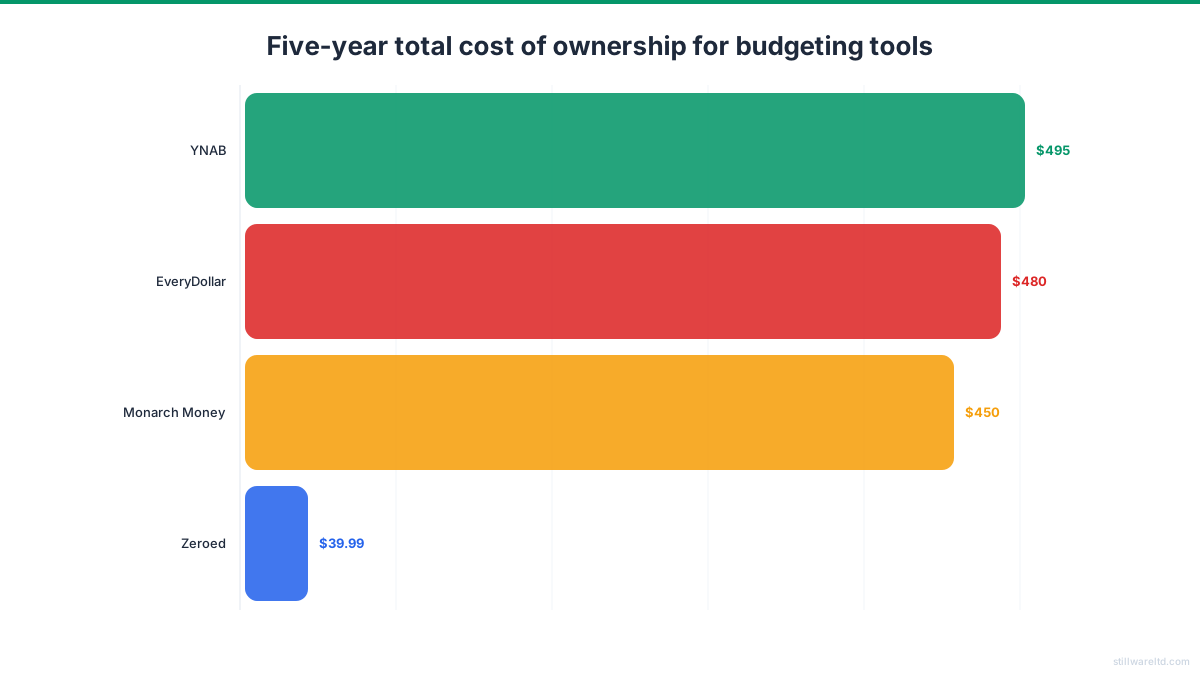
We benchmarked the cost of using a tool like Zeroed against leading subscription alternatives. The 5-year cost difference isn’t trivial—it’s often over $500. That’s money that could be in your “Emergency Fund” or “Vacation” category. A one-time purchase for a budgeting tool aligns perfectly with the philosophy of owning your financial future, not renting it month-to-month. For a deeper dive, see our analysis in The True Cost of YNAB Over 5 Years.
The Tool That Respects the Method
Zero-based budgeting requires honesty and detail. You are creating a digital map of your priorities. That map deserves to be kept secure and private, not stored on a company server where it could be breached, mined, or lost if the service shuts down.
A proper zero-based budgeting tool should have zero telemetry, zero required sign-ins, and zero subscriptions. It should use military-grade encryption on your device and, if you choose to sync across your phone and laptop, use your own Google Drive as a private conduit—we just provide the encrypted wallet, you hold the keys. This architecture isn’t a marketing gimmick; it’s a necessity for software that holds your financial life. Learn more about our approach in How Zeroed Encrypts Your Data Without a Server.
Your budget is a personal blueprint. It should work in the doctor’s office waiting room with no Wi-Fi, on the subway without a signal, or at your kitchen table. It shouldn’t phone home.
Ready to give every dollar a purposeful job? The method demands intention, and the right tool should protect that intention fiercely. Try Zeroed free for 34 days—it’s a one-time purchase, built specifically for this manual, private, and powerful approach to money.
Try Zeroed Free — a one-time purchase for intentional budgeting
Try Zeroed Free