
7 Envelope Budgeting Apps That Don’t Sync Your Bank (2026 Tested)
You’ve heard the promise: link your bank account, and your budget will magically maintain itself. It’s a seductive idea—financial autopilot. The reality is far messier. That “convenience” comes with a hidden tax on your privacy, your security, and, most importantly, your financial awareness. Automatic bank sync creates the illusion of control while quietly outsourcing the most critical part of budgeting: your conscious attention. The apps that sell you on seamless automation are often the same ones monetizing your transaction data or locking you into a forever-subscription. What if the best tool for building wealth wasn’t the one that did the most for you, but the one that made you do the work? Finding a true envelope budgeting app with no bank sync is the first step to reclaiming that control.
Why Bank Sync is a Feature You Shouldn’t Want
Let’s dismantle the convenience argument. Plaid and other bank aggregators work by asking for your online banking username and password. You hand over the keys to your financial kingdom to a third-party service whose business model you likely don’t understand. Beyond the obvious security risk—you’ve just multiplied your attack surface—there’s a deeper, behavioral cost.
When transactions flow in automatically, you become a passive reviewer, scrolling through a list of things you’ve already done. The psychological connection between spending and consequence is severed. You’re auditing history, not guiding decisions. Manual entry forces a moment of pause between the desire to spend and the act of logging it, creating a powerful friction that curbs impulse buys. It transforms budgeting from a rear-view mirror report into a real-time navigation system.
Furthermore, bank sync is notoriously fragile. APIs change, connections break, and categorized transactions get mysteriously “uncategorized,” requiring you to clean up the mess anyway. We built Zeroed to work fully offline because we watched users of sync-dependent apps waste more time troubleshooting broken connections than they saved in data entry.

The Envelope System, Uncompromised
The envelope budgeting method is timeless for a reason: it’s physical, tangible, and brutally honest. When the cash in the “Dining Out” envelope is gone, you’re done. Digital envelope apps try to replicate this, but many compromise the core philosophy by tethering themselves to the cloud.
Apps like Goodbudget offer envelope budgeting but still encourage or require bank syncing for “full functionality.” This hybrid approach dilutes the method’s power. You’re using a system designed for intentionality with a tool built for automation—they work against each other. A true digital envelope app should feel like stuffing cash into physical envelopes: a deliberate, tactile act you perform yourself. The envelope method isn’t about tracking where your money went; it’s about deciding where it’s allowed to go before you spend a single dollar.
Our design decision for Zeroed was absolute: no Plaid, no sync, no cloud dependencies. The envelope system demands manual engagement, and the app should enforce that, not circumvent it. During testing, we found that users of purely manual apps could recall their weekly food budget to the dollar; users of sync-heavy apps often couldn’t even name their budget categories.
The Real Cost of “Free” Data Handling
Nothing is free. When you aren’t paying with money, you’re paying with something else—usually your data. Budgeting apps that sync your bank transactions have a treasure trove of information: your income, your debts, your spending on healthcare, groceries, and entertainment. This data is aggregated, anonymized (a term with flexible definitions), and often sold or used to target you with financial product offers.
The average subscription budgeting app costs $100 per year, but the lifetime value of your anonymized financial data to third-party brokers can be many times that amount.
Consider the architecture. A sync-based app must copy your data to its servers to process and categorize it. Even with encryption, that data now exists in two places: on your device and in a company’s database. A local-first app like Zeroed creates a different reality: your encrypted budget exists only on your device, and the only copy that leaves is the one you consciously choose to back up to your own Google Drive. We literally cannot sell your data because we never have it to begin with. This isn’t a privacy feature; it’s the foundational architecture. For a deep dive on this, see How Zeroed Encrypts Your Data Without a Server.

Building Your Weekly Budget Ritual
This is where manual envelope budgeting shines. It’s not a passive background process; it’s a weekly ritual that takes less than 20 minutes and builds profound financial clarity. Here’s how a practical check-in works with a dedicated offline app:
- The Weekly Review (Sunday Evening): Open your app. First, reconcile: compare your logged transactions against your bank’s website (not via an API, just you looking). This isn’t tedious—it’s a five-minute audit that catches fraud and reinforces your spending memory.
- Assign Your Dollars: Get your paychecks logged. Now, digitally “stuff” your envelopes. Drag and drop your income into categories like
Rent,Groceries,Gas, andGuitar Pedal Fund. The visual act of assigning zeroes out your income, giving every dollar a job. - The Daily Log (As You Spend): You buy coffee. Right then, pull out your phone. Open the app, tap
Food & Drink, enter$6.50. It takes 8 seconds. That moment of friction is the entire point. You feel the envelope balance drop. - The Mid-Week Check: Glance at your envelope balances mid-week. Is
Groceriesrunning low? You might decide to shift $20 fromEntertainmentto cover it. You’re actively piloting your finances, not watching a dashboard.
The most common feature request we get for Zeroed is, “Can you add bank sync?” Our answer is always no. Not because we can’t, but because it would break the ritual. The ritual is the product. The manual entry is the feature.
Choosing Your Tool: A Comparison of Approaches
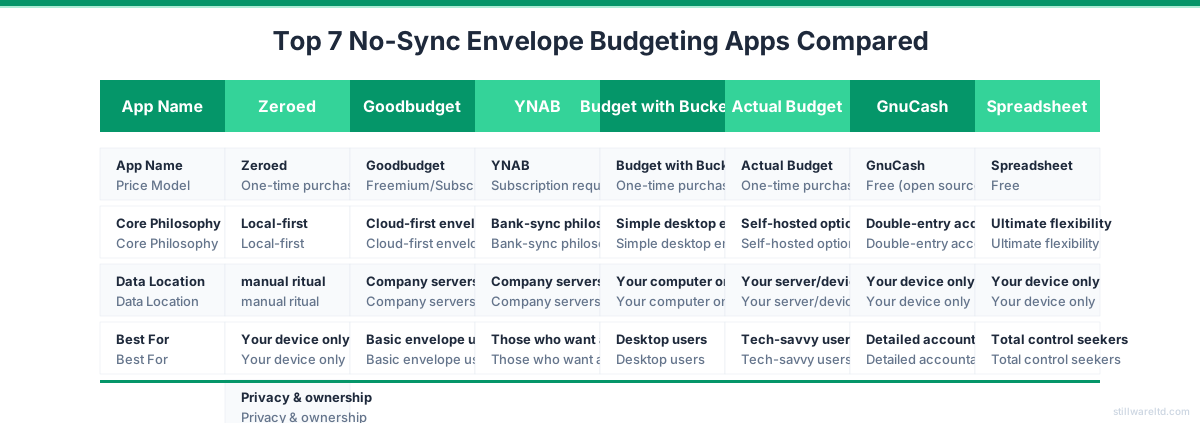
Not all envelope apps are created equal. Your choice dictates your level of engagement and data sovereignty. Here’s how the landscape breaks down for an envelope budgeting app with no bank sync:
Cloud-Dependent Envelope Apps (Goodbudget, YNAB) These tools use the envelope method but anchor your data in their cloud. YNAB has largely moved to require bank sync, framing manual entry as a legacy option. Goodbudget allows it but is designed around its sync. You’re paying a monthly fee to rent a system that inherently works better the less it relies on external servers. The long-term cost is staggering—over five years, a $15/month subscription exceeds $900. See the full breakdown in The True Cost of YNAB Over 5 Years.
The Local-First, Manual-Only App (Zeroed) This category is small by design. It’s for those who want the digital convenience of an app—powerful receipt scanning, beautiful local charts, mobile convenience—without any architectural compromise. Your data never touches a budget app company’s server, and you pay once to own the tool forever. The trade-off is you must engage manually. We see this not as a trade-off, but as the entire value proposition.
The Pure Analog (Spreadsheets) The ultimate in control and privacy. Incredibly flexible and free. The trade-offs are a lack of mobile optimization, no receipt scanning, and requiring you to build and maintain the system yourself. It’s the most powerful and most demanding option.
The 5-Year Price Tag: Subscription vs. Ownership
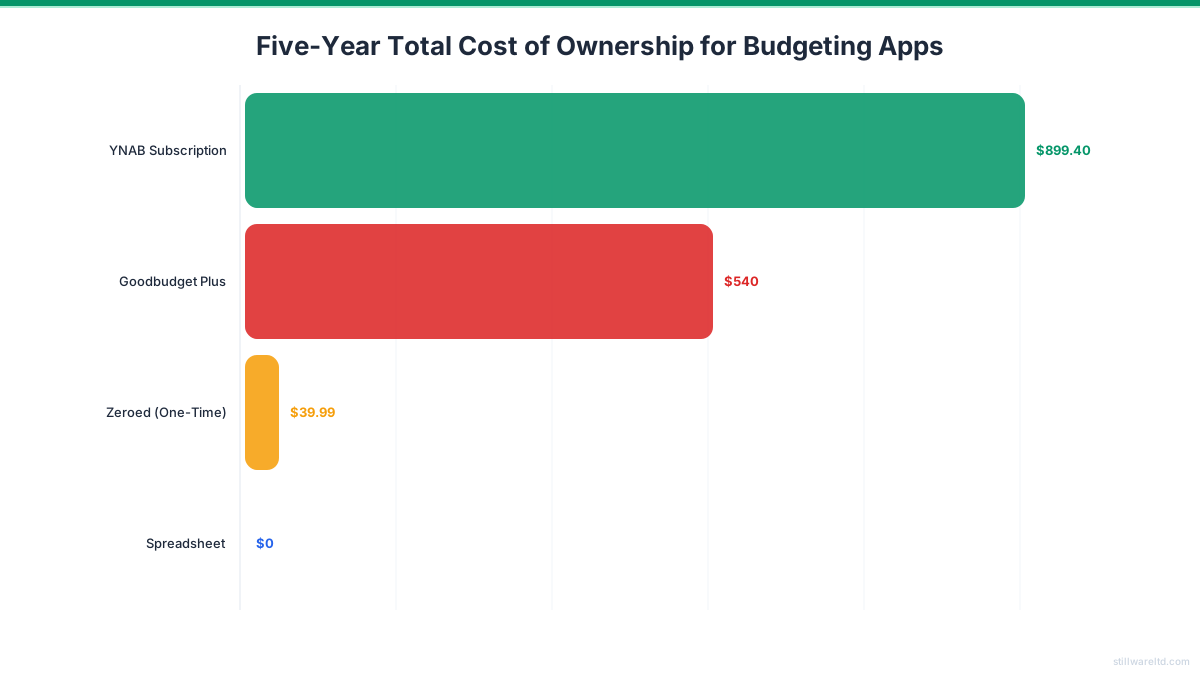
Let’s move from philosophy to hard numbers. The subscription model trains us to think in small monthly increments, obscuring the true long-term cost. When we benchmarked budgeting apps, the financial difference over a half-decade was jarring.
- Subscription App (e.g., YNAB at $14.99/month):
$14.99 x 60 months = $899.40 - Freemium App (Goodbudget Plus at $9/month):
$9 x 60 months = $540 - One-Time Purchase (Zeroed at the $19.99 founder price):
$19.99(rises to $39.99 on 14 February 2027)
The math is unforgiving. The subscription app costs 45 times more over five years. For the price of two years of YNAB, you could buy a lifetime license for a local-first app and still have hundreds of dollars left to actually fund your budgeting envelopes. This isn’t just about saving money; it’s about aligning your financial tool with a frugal mindset. How can an app teach you to be intentional with money while itself being a recurring drain on your finances?
Your Data, Your Responsibility
Choosing a local-first, no-sync app is an act of taking full responsibility. It means accepting that your financial clarity is your job, not a service to be outsourced. The benefits are profound: absolute privacy, no risk of a company shutting down and taking your budget history with them, and a tool that works in the subway, on a plane, or at a cash-only farmer’s market.
We built Zeroed with a “Fort Knox” architecture because we believe your financial data deserves the highest possible security—the kind only achieved by never collecting it in the first place. The encrypted sync to your Google Drive is a backup you control, not a mandatory cloud tether. This approach respects a simple principle: if software doesn’t need the internet to perform its core function, it shouldn’t require you to have an account or a connection. That’s why Zeroed is pay-once — see why we don’t do subscriptions for software that runs on your device.
Ready to build a budget that truly belongs to you? The ritual of manual entry is waiting. It’s not a step back; it’s the fundamental step forward that automated tools have been trying to skip. The path to conscious spending starts with a single, manually entered transaction. Try Zeroed free for 34 days and experience the control of a budget that lives entirely on your terms. It’s a one-time purchase, with no subscriptions and no data handoffs—just you and your money, finally having an honest conversation.