
5 YNAB Alternatives That Keep Your Data Local (2026 Tested)
You print your bank statement, grab a highlighter, and sit down at the kitchen table. For the next hour, you categorize transactions, your coffee going cold. You finally have a clear picture of last month. You open your budgeting app to input the numbers. A spinning wheel appears. “Connection Error.” The app’s servers are down, or your Wi-Fi is spotty, or the bank’s API is having a moment. Your carefully compiled data is stuck on a piece of paper, useless to the digital system you pay to use.
This isn’t a bug; it’s a philosophical flaw. You’re renting a tool that fails the moment you need it to work independently. The promise of automation has tethered your financial awareness to the reliability of a dozen external services. When one link breaks, your entire system grinds to a halt.
The search for alternatives to YNAB with local storage isn’t just about features or price. It’s a quest for sovereignty. It’s about finding a budgeting tool that works like a hammer in your hand, not a power tool leased from a company that controls the outlet.

Cloud-First vs. Device-First: The Architecture of Trust
To understand the alternatives, you must first see the blueprint of the tool you’re using. Most modern budgeting apps, YNAB included, are built on a cloud-first architecture. Your data lives on their servers. Your app is a window. This design enables slick features like instant syncing across devices and automated bank imports via services like Plaid.
But that convenience has a cost structure and a risk profile.
A device-first or local-storage app reverses the model. Your budget database lives on your phone, tablet, or computer. The app is the workshop, not just a viewport. Syncing, if it exists, is an optional export/import process or uses a storage medium you control, like an encrypted file in your personal Google Drive or iCloud.
The choice between a cloud-first and a device-first budget app is the choice between being a tenant and being an owner. As a tenant, you have limited control over the premises and pay monthly for the privilege. As an owner, you bear the responsibility of maintenance, but the asset is unequivocally yours.
When we built Zeroed, this was the foundational design decision. We chose a device-first, fully offline model because the core act of budgeting—allocating money you have to jobs it needs to do—doesn’t require a live internet connection. The complexity and privacy cost of cloud architecture felt like over-engineering for the problem at hand.
The 5-Year Cost Breakdown: Subscription vs. Ownership
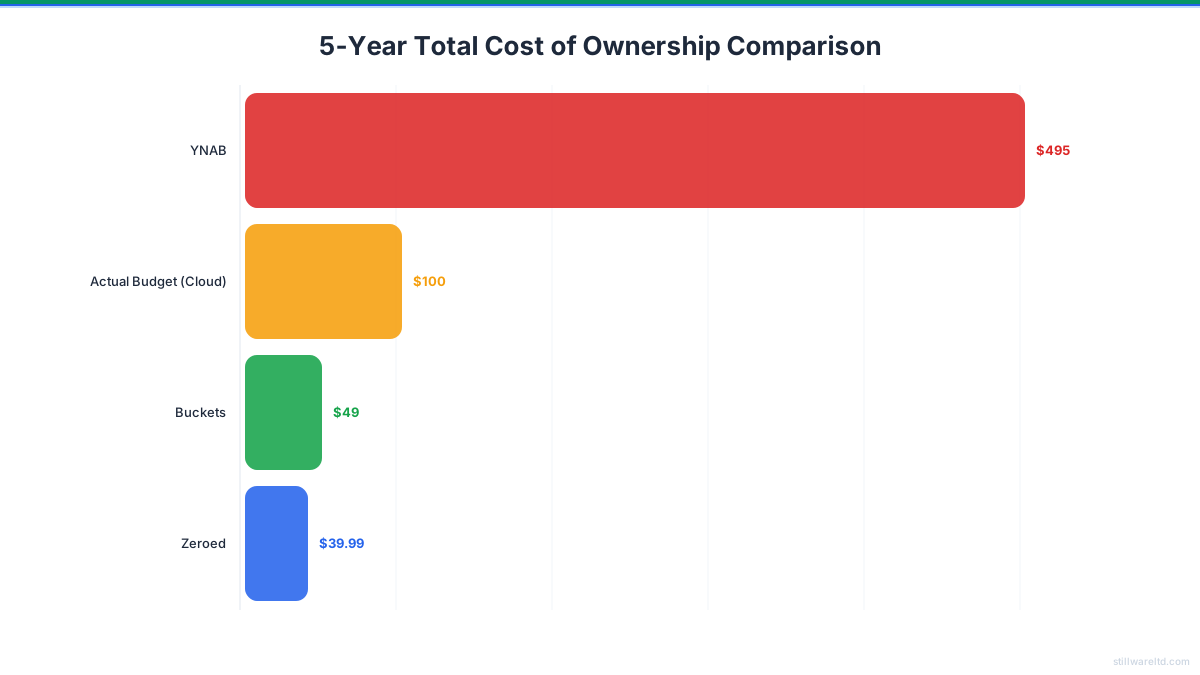
Let’s move from philosophy to finance. The most glaring difference between YNAB and local-storage alternatives is the pricing model. YNAB operates on a subscription, currently $14.99 per month or $99 per year. The alternatives are almost universally one-time purchases.
This isn’t a minor price difference. It’s a fundamental divergence in what you’re buying.
The average subscriber will pay nearly $500 to YNAB over five years for a service that could be replaced by a $50 tool they own forever.
Consider a five-year timeline, a reasonable period for using a financial system:
| Budgeting App | Model | Upfront Cost | 5-Year Cost | Data Location |
|---|---|---|---|---|
| YNAB | Subscription | $0 | $495 (or $499.40 monthly) | Company Servers |
| Actual Budget | One-time | ~$4/month (self-host) or $20/yr (cloud) | $20 - $100 (varies) | Your Server or Theirs |
| Buckets | One-time | $49 | $49 | Your Device |
| Zeroed | One-time | $39.99 (early price) | $39.99 | Your Device |
The math is unforgiving. The subscription model is spectacular for business revenue but often brutal for user lifetime value. For the cost of five years with YNAB, you could buy Buckets, Zeroed, and a nice dinner, and still have over $400 left to put in your emergency fund.
We benchmarked this early on. The question wasn’t just “can we build a good budgeting app?” It was “can we build a financially sane one that doesn’t become a recurring line item in the very budget it’s meant to help manage?” The 5-year TCO became our north star. For a deeper dive, see our analysis on The True Cost of YNAB Over 5 Years.
Feature Comparison: What You Gain and What You Trade
A lower price is meaningless if the tool doesn’t work. Let’s compare the practical experience of using a cloud-subscription app versus a local-storage alternative. This isn’t about declaring a universal winner; it’s about matching a tool to your tolerance for manual input and your requirement for privacy.
1. Transaction Input: Automation vs. Auditing
- YNAB/Cloud Apps: Automated import via Plaid or similar. Transactions flow in, you categorize them. It’s fast but can be messy—duplicates, mis-categorizations, and a lag of 1-3 days are common. You trade control for convenience.
- Local Alternatives (Buckets, Zeroed): Almost exclusively manual entry or file import (CSV, OFX). You type in each transaction or upload a statement from your bank’s website. This manual process, often seen as a drawback, forces a weekly or daily audit of your spending that fundamentally changes your relationship with money. You can’t be passive.
2. Data Access & Sync: Their Cloud vs. Your Drive
- YNAB/Cloud Apps: Open the app on any device, log in, and your budget is there. It’s seamless because they hold the single source of truth. If their service is discontinued, your access to that data format may vanish.
- Local Alternatives: Your data is on the device where you entered it. To sync, you must use a method you manage. Buckets uses a proprietary sync file you must move manually. Zeroed uses an encrypted database that syncs via your own Google Drive. You hold the keys, and the data is in standard SQLite/JSON formats, ensuring you can always access it, even if the app disappears.
3. Privacy & Security: The Invisible Feature
- YNAB/Cloud Apps: Your financial transaction history—a map of your life—resides on their servers. They encrypt it, but they hold the encryption keys. They have a privacy policy, but the data is still a target for breaches and a source for internal analytics.
- Local Alternatives: The data never leaves your device unless you explicitly back it up. There is no account, no email on file, no central server to breach. This isn’t just a “feature”; it’s the removal of an entire category of risk. For us, this was non-negotiable. We literally cannot sell your data because we never have it to begin with. Learn more about our approach in How Zeroed Encrypts Your Data Without a Server.
4. Reliability & Offline Functionality
- YNAB/Cloud Apps: Requires an internet connection for full functionality. No signal, no app. Service outages affect all users simultaneously.
- Local Alternatives: Work 100% offline. You can budget on a plane, in a basement, or in the woods. An app outage is a personal hardware problem, not a global one.

5 Questions to Ask Before Switching to a Local App
Choosing a local-storage alternative requires introspection. It’s not for everyone. Ask yourself these questions:
- Am I willing to trade 10 minutes of manual entry for ~$100/year and total data privacy? This is the core trade. Calculate your hourly rate against the subscription savings.
- Do I need real-time, automated bank sync, or is a weekly “statement reconciliation” ritual acceptable? Many find the weekly review more grounding.
- How critical is accessing my budget from any random browser on earth? If you must access it from a library computer, cloud wins. If you use your own devices, local sync (like Google Drive) works fine.
- What is my threat model? Are you worried about corporate data mining, potential breaches, or just general digital clutter? The stronger your privacy concern, the more a local app makes sense.
- Do I want to own a tool or rent a service? This is the philosophical heart of it. Ownership comes with more responsibility but also permanence and freedom.
The most common request we get for Zeroed is, “Can you add Plaid bank sync?” Our answer is always no. Not because it’s technically hard, but because it would violate the core principle of the app: your data stays with you. Introducing a third-party service that scrapes your bank credentials and stores your transaction history on its servers would break the model we built.
The Contenders: A Close Look at 3 Local-First Alternatives
Let’s move from theory to specific tools. Here are the notable offline YNAB alternatives that prioritize local data storage.
Actual Budget: The Open-Source Powerhouse
Actual is a unique beast. It’s a powerful, YNAB-inspired envelope budgeting tool that you can self-host for free (data completely on your server) or use their cloud service for a small fee. Its interface is clean and focused.
- Local Storage Model: Self-hosted version gives you ultimate control. Cloud version is still relatively private and cheap.
- Cost: Free (self-host) or ~$20/year (cloud).
- Best For: Tech-savvy users who want YNAB’s philosophy with more control and a lower price.
Buckets: The Charming, Straightforward Envelope System
Buckets is a one-time purchase app that embodies simplicity. It uses the envelope metaphor perfectly and stores everything locally. Its “sync” is manually moving a file between devices.
- Local Storage Model: 100% local. Sync via manual file copy.
- Cost: $49 one-time.
- Best For: Individuals or single-device users who want a no-fuss, lifetime envelope system without any cloud fuss.
Zeroed: The Hardcore, Zero-Trust Option
Full disclosure: we built Zeroed. It’s designed for the privacy-maximalist who wants a powerful envelope system with modern features like on-device receipt scanning, but with an ironclad local-first promise. No accounts, no telemetry, no cloud dependencies.
- Local Storage Model: 100% local with optional, end-to-end encrypted sync via your personal Google Drive. The app cannot read your synced data without the key on your device.
- Cost: $39.99 one-time (early adopter price).
- Best For: Users who prioritize privacy above all else, want a one-time purchase, and appreciate powerful local tools like OCR scanning without data leaving their device.

How to Switch: A 5-Step Migration Plan
Switching budget systems is a project. It’s worth doing right.
- Pick Your New App: Download the trials. Use Zeroed’s 34-day free trial, try Buckets, or set up Actual. Use them concurrently with your old app for a month.
- Export Your Data: From YNAB, use their export tool to get a CSV of your transactions and budget categories. This is your starting point.
- Set Up Your New Structure: Recreate your budget categories in the new app. This is a good time to simplify and rethink old categories.
- The Fresh Start Balance: On your switch date, input your current account balances. Don’t try to import every historical transaction. Start fresh from this moment forward. Historical reports are less valuable than a clean, current system.
- Embrace the Ritual: Schedule 15 minutes, twice a week, to input transactions. Use your bank’s website or app as your source. This ritual is where the magic happens—it turns budgeting from a passive observation into an active management task.
When we tested Zeroed against subscription alternatives, the performance difference was negligible—apps open instantly when they don’t need to phone home. The real difference was in the user’s posture: engaged versus observational.
Your Data, Your Device, Your Choice
The search for a budget app with no cloud sync is a quiet rebellion against the assumption that our most sensitive data must be stored on a corporation’s server to be useful. It’s a bet on the processing power of the device in your pocket and your own willingness to be hands-on.
YNAB is a fantastic service that has helped millions. But it is a service—a rental. The alternatives like Actual Budget, Buckets, and Zeroed are tools you own. They may require a bit more elbow grease, but they repay you with permanent ownership, profound privacy, and the deep financial awareness that comes from manually steering your money.
The receipt on the fridge doesn’t have to be a dead end. It can be the primary source for a system that answers only to you. Ready to own your budget instead of renting it? Try Zeroed free for 34 days—it’s a one-time purchase, and your data never has to leave your hands.
Try Zeroed — a one-time purchase, local-first budgeting app
Try Zeroed