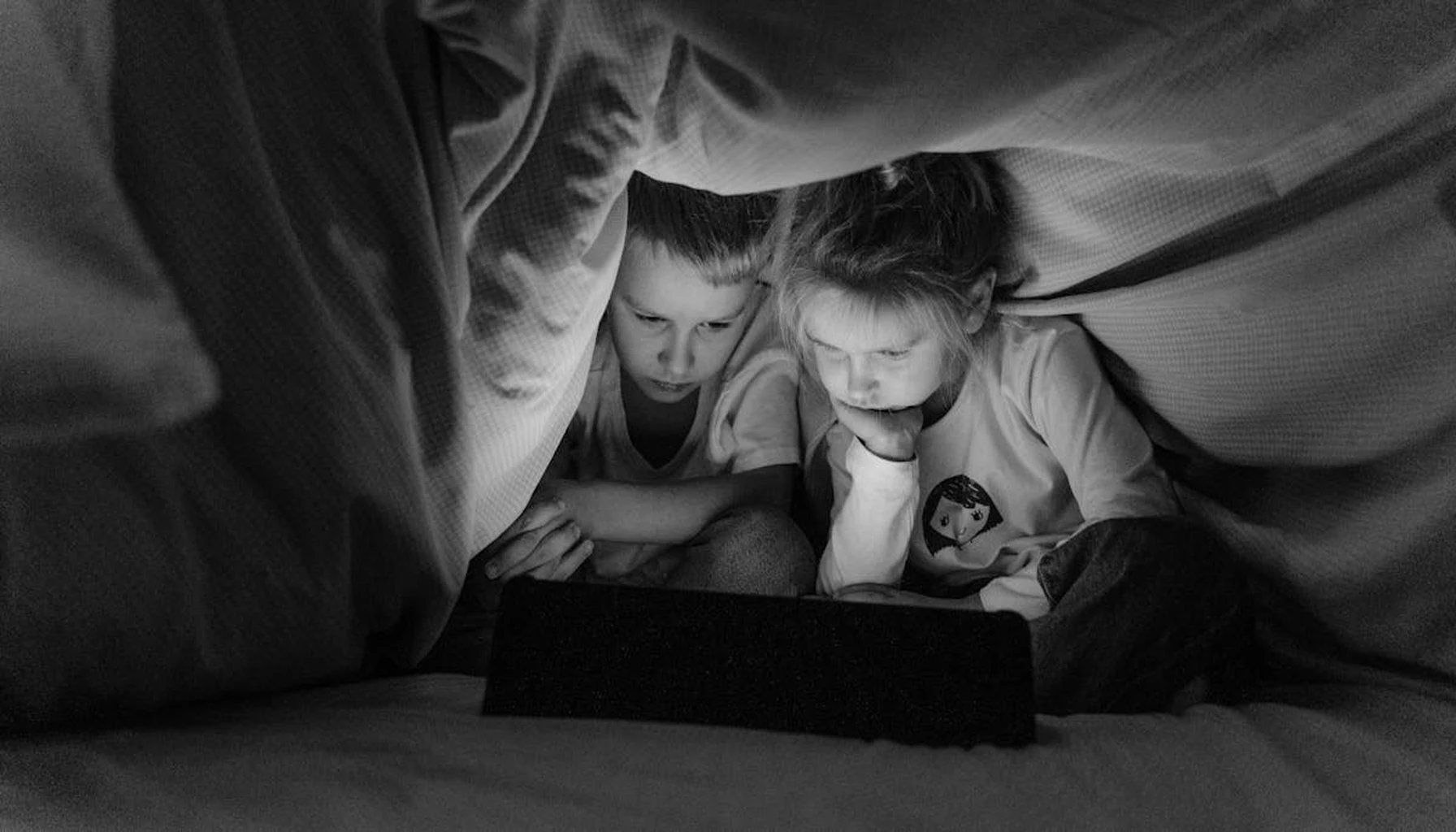
The Myth of the “Safe” Digital Panopticon
We’re told that keeping kids safe online means watching everything they do. The parental control industry sells a simple promise: total visibility equals total safety. Install this app, and you’ll see every search, every message, every tap. It’s the digital equivalent of putting a security camera in your child’s bedroom—for their own good, of course. This is the core argument against why kids deserve digital privacy.
We’ve been researching kids’ journaling and diary apps while designing local-first tools at Stillware. The results were unsettling. The top “private diary” apps for kids on the App Store — the ones marketed with lock icons and promises of secrecy — almost all sync to cloud servers. One popular app’s privacy policy stated it collects “content of entries” for “service improvement.” A child’s private thoughts, uploaded to a company server for analytics. That’s not a diary; that’s a honeypot with a padlock sticker on it.
The reality is more complicated, and far more damaging. Constant surveillance doesn’t build trust; it teaches children that their inner world is not their own. It conditions them to perform for an audience, even in spaces meant for raw, unfiltered self-exploration. The locked paper diary under the mattress wasn’t just a trope; it was a critical developmental tool. Its digital equivalent shouldn’t be a trap that reports back to headquarters.
This isn’t about letting kids run wild on the internet. It’s about recognizing that a private, local space for thought is not a security threat—it’s a psychological necessity. The goal shouldn’t be to eliminate privacy, but to architect it safely.

3 Reasons Why Kids Deserve Digital Privacy
Childhood development is, at its core, a process of identity formation. Kids test ideas, voice fears, and explore emotions they’re not ready to share. A diary—digital or otherwise—is the practice field for their inner life.
The act of writing something down, knowing it is for your eyes only, is a profound exercise in self-validation. It’s where a child can be angry at a parent, confused by a friendship, or wildly imaginative without fear of judgment or correction. This process helps them understand their own emotions, separate from the expectations of others.
Take this private space away, and you replace self-reflection with performance. If a child knows their journal entries are being monitored, the writing changes. It becomes what they think you want to read, or a deliberate provocation, but never the honest, messy truth they need to process. You haven’t gained insight; you’ve lost a window into their authentic self.
The argument for surveillance often hinges on safety from external threats. But we must ask: safety from whom? The greater risk isn’t a child’s private musings, but the architecture that exposes them. A journal entry in a locally encrypted app on a device in their hand is orders of magnitude safer than one typed into a “free” cloud-based app that mines data for advertising profiles.
The Sibling-Proof Digital Journal: Beyond Parental Controls
Parental control apps are designed for the internet—a vast, external wilderness. They are border guards. But a journal is a domestic space, a bedroom. The threats here are different: a nosy sibling borrowing a tablet, a friend scrolling through photos, the accidental exposure of a deeply personal thought.
This demands a different kind of security, one focused on local integrity rather than external monitoring. A secure diary app for children needs to solve for the physical reality of a shared device in a family home.
- Local Encryption as a Lock: The diary should be encrypted with a key only the child knows. Not a parent’s master key. This teaches a fundamental principle: you own your thoughts.
- The Decoy Mode (The Empty Notebook): This is a genius feature for social pressure. If a sibling demands to see the diary, the child can enter a decoy password to open a boring, empty notebook. It preserves privacy without creating a confrontational secret.
- Zero Cloud Uploads: This is the critical architectural guarantee. The journal never leaves the device unless the child explicitly exports it. No startup’s server ever holds a page of it. This eliminates the risk of a data breach exposing a decade of childhood introspection to the internet.
The result isn’t less safety, but safety of a different, more meaningful kind: safety from exposure, from embarrassment, from having your formative thoughts become a data point. It’s the digital equivalent of giving them a room with a door that locks, instead of a cubicle in an open-plan office.

Quick Wins: What You Can Do Today
You don’t need to be a tech expert or wait for the perfect app to start respecting digital privacy. Here are three actionable steps you can implement immediately.
- Audit the “Free” Apps. Check the permissions on your child’s current journal or note-taking apps. Does it require an internet connection? Does its privacy policy mention “data analytics,” “third-party sharing,” or “improving user experience”? If yes, it’s likely not private. Switch to a device-native notes app that works offline.
- Have “The Key Talk.” Frame encryption as a superpower. Explain that a password isn’t just to keep others out; it’s a key that protects their words so they can be truly honest. Offer to help them create a strong, memorable passphrase they’ve never used before.
- Establish a Privacy Compact. Make an agreement: “Your journal on your device is your private space. I will not ask for your password or read it without your explicit permission, even if I technically can. In return, you use that space responsibly.” This builds trust through demonstrated respect, not through invasive verification.
Trust Through Architecture, Not Through Surveillance
The prevailing model is one of mistrust codified into software. We assume the worst and build systems to catch it. This creates an adversarial dynamic and, ironically, teaches kids to become better at hiding things in the shadows—the very behavior surveillance aims to prevent.
The alternative is what we call “trust through architecture.” You build a device or app that is physically incapable of betraying a secret. The journal can’t sync to the cloud because you didn’t write that code. It can’t send analytics because there’s no network call. The parent’s trust comes from the constraints of the tool, not from a daily log review.
This flips the script. Instead of the parent being the warden checking the logs, they become the provider of a safe tool. The child is entrusted with real responsibility—keeping their own key. This is a far more powerful lesson in digital citizenship than passive monitoring ever could be.
It acknowledges a simple truth: we cannot spy our way into our children’s confidence. We can only create conditions where they feel safe enough to share it voluntarily, on their own terms.
Our stance at Stillware is unambiguous: if a child’s app can’t work with airplane mode on, it has no business calling itself private. We design every tool with the assumption that the network is hostile. No cloud sync, no telemetry, no “anonymous” usage data. The architecture itself is the promise — not a privacy policy that can change with the next quarterly report.

The Bridge Back to the Physical World
A private digital journal shouldn’t be a black hole. Its value is often realized when it bridges back to the tangible world. This is where local-first design shines.
Imagine a child who’s been journaling about anxiety over a school project. They can, when they choose to, export those entries as a simple text file or print them out. They might bring that printout to a parent and say, “This is what I’ve been feeling.” That moment of voluntary sharing, born from a secure private space, is infinitely more valuable than a parent stumbling across a flagged keyword in a monitoring dashboard.
Or consider audio logs or drawings saved in the journal. These become digital artifacts of a childhood that can be manually backed up to a family computer or a USB drive the child controls—creating a personal archive, not a corporate data asset. The process teaches curation, ownership, and the technical skill of managing one’s own data.
This approach prepares them for adulthood, where they will need to manage their own digital privacy without a parental dashboard to rely on. It’s the difference between teaching someone to drive by putting them in a car with a remote kill switch, versus teaching them the rules of the road and the mechanics of the brake pedal.
When we were designing our approach to kids’ tools, we tested a simple experiment: we gave a child a journal app that required login and one that just opened to a blank page. The child wrote three sentences in the login app. In the instant-open app, they filled two pages. The friction wasn’t just technical — it was psychological. A login screen says “someone is watching.” A blank page says “this is yours.”
How to Start Building Digital Trust Today
The conversation about kids and technology is stuck on a binary: unfettered access versus locked-down surveillance. We’re missing the middle ground—intentionally designed private spaces. A child’s right to digital privacy isn’t about keeping secrets from parents; it’s about having the cognitive space to form a self worth sharing in the first place.
It’s about building tools that protect by design, not by intrusion. This philosophy extends beyond journals to all software. It’s why we believe in one-time purchases over subscriptions—ownership fosters a different, more responsible relationship with technology.
Ready to move from surveillance to trust? Start by having “The Key Talk” with your child today and explore tools that respect their digital privacy from the ground up. For a deeper look at how software ownership changes the dynamic, read our take on why we don’t do subscriptions.