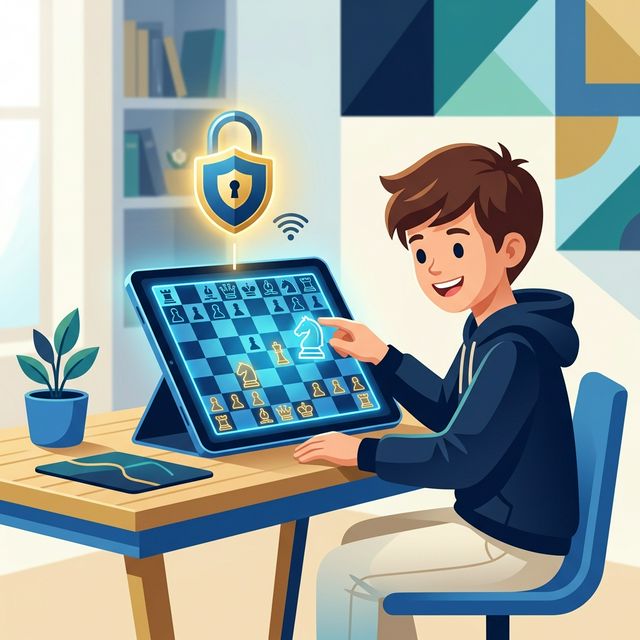
What You’ll Learn About Offline Chess Apps for Kids
You’re about to find the single best offline chess app for kids that works without Wi-Fi, collects zero data, and costs you one time. We’ll cut through the noise of subscription-based platforms and show you exactly what features matter for real learning. By the end, you’ll know how to choose an app that turns screen time into focused, ad-free strategic thinking—whether you’re on a road trip, in a waiting room, or just want a break from the internet.
The right chess app isn’t just about teaching moves; it’s about creating a private, focused space for a young mind to grow.

The Hidden Costs of “Free” Online Chess Platforms
Most popular chess apps for kids operate on a simple, troubling model: give the game away for free, then monetize attention and data. They require constant internet, feature chat functions, and are packed with ads or aggressive upgrade prompts. For a parent, this creates three major problems.
First, the learning environment is fractured. Notifications, multiplayer invites, and banner ads constantly pull a child’s focus away from the board. Second, you’re often forced into a subscription to remove these distractions and access deeper lessons. What starts as a free download can easily become a $10/month commitment. Third, and most critically, these platforms are data honeypots. To provide multiplayer matching and cloud saves, they require accounts, track progress, and often analyze play patterns.
Consider the typical feature set of a mainstream kids’ chess app:
- Always-Online Requirement: No internet means no access to puzzles, lessons, or even the AI opponent.
- Account Mandate: An email and password are needed, creating a data footprint for a child.
- Social & Chat Features: While sometimes moderated, these open a door to unwanted interactions.
- Subscription Gatekeeping: Core educational content is locked behind a monthly paywall.
- Data-Driven Analytics: Play data is collected to “improve the service” and target ads or promotions.
You’re not just paying with money; you’re paying with your child’s privacy and uninterrupted attention. After months of researching the space before building Rank Up Chess, the biggest surprise was how few options treated a child’s chess progress as private, owned data rather than a behavioral analytics stream.
Why Offline Functionality is Non-Negotiable for Learning
Chess is a game of deep concentration. The ideal learning environment is silent, immersive, and free from external pings. An offline app architecturally guarantees this. It transforms a tablet or phone into a self-contained chess tutor, available anywhere—a feature that unlocks powerful real-world scenarios.
Think about the places where kids have time to kill but where Wi-Fi is spotty or nonexistent:
- Long road trips and flights
- Waiting at the doctor’s office or for a sibling’s practice to end
- Rural areas or vacations with poor connectivity
- Schools that require devices to be in airplane mode
- Simply wanting to limit a child’s overall internet exposure
The average educational app interrupts a child’s focus every 4 minutes with a notification, ad, or request to connect. An offline-first app removes the very mechanism of interruption.
Beyond focus, offline means ownership. The app, its curriculum, and the child’s progress live entirely on your device. There’s no risk of a company shutting down its servers and erasing years of achievement badges or saved games. The child’s learning journey is a permanent, local file you control, not a temporary rental on a corporate cloud.
The Essential Features of a Standalone Chess Tutor
If an app doesn’t need the internet, it must be exceptionally well-stocked locally. A serious offline chess app for kids should function as a complete academy in your pocket. Here’s what to look for, moving beyond basic play-against-the-computer functionality.
A Structured, Progressive Curriculum Random puzzles are fun, but mastery requires a path. A quality app will have chapters or modules that build concepts sequentially:
- The Absolute Basics: How pieces move, the objective of checkmate.
- Fundamental Tactics: Pins, forks, skewers, and discovered attacks.
- Opening Principles: Controlling the center, developing pieces, king safety.
- Middle Game Strategy: Planning, pawn structure, piece coordination.
- Endgame Technique: King and pawn endings, basic checkmates.
- Advanced Analysis: Learning from your own games.
A Truly Adaptable AI Opponent The computer shouldn’t just be strong or weak; it should learn and teach. Look for an AI with multiple, well-defined difficulty levels that mimic human playing styles. The best ones, like the Stockfish 16 engine we integrated into Rank Up Chess, offer post-game analysis to explain critical mistakes and show better moves.
A Vast, Offline Puzzle Library Tactical pattern recognition is the core of chess improvement. An app needs thousands of puzzles, categorized by theme (mate in 1, forks, endgames) and difficulty, all stored on-device.
Multi-User Profiles for Families One device often serves multiple children. Individual profiles let each child track their own progress through lessons, puzzle scores, and achievements without mixing up data.
Beta testers for Rank Up Chess told us the feature they valued most wasn’t flashy graphics—it was the detailed, post-game analysis that turned a loss into a concrete lesson. That’s the hallmark of a true educational tool.

Privacy and Safety: More Than Just a Buzzword
When an app is designed for children, privacy isn’t a feature—it’s the foundation. The Children’s Online Privacy Protection Act (COPPA) sets strict rules, but compliance is the bare minimum. A privacy-first philosophy shapes every architectural decision.
We deliberately left out common “engagement” features from Rank Up Chess, like chat rooms or friend leaderboards that connect to the internet. Here’s why: each online social feature requires a server, an account, and a data pipeline. Removing them isn’t limiting the app; it’s defining its purpose as a pure, safe learning sanctuary. There are no usernames, no passwords, and no way for the app to “phone home” because it has nowhere to call.
A COPPA-compliant, offline app ensures your child’s chess development is a private story, not a data point in an analytics dashboard. This approach provides tangible peace of mind:
- No Data Breach Risk: Data that isn’t collected can’t be leaked.
- No Behavioral Profiling: Play patterns aren’t analyzed to serve ads or recommend other products.
- No In-App Purchase Traps: A one-time purchase model eliminates the psychological tricks of microtransactions.
- No Surprise Contacts: With no chat functions, there’s zero risk of interaction with strangers.
The app becomes a tool you hand to your child with the same confidence as a book or a physical chessboard—it’s self-contained, predictable, and safe.
The Financial Logic of Owning vs. Renting Education
Let’s talk numbers. The leading subscription-based kids’ chess app costs around $10 per month. That seems manageable until you project it over the 3-5 years a child might seriously engage with the hobby.
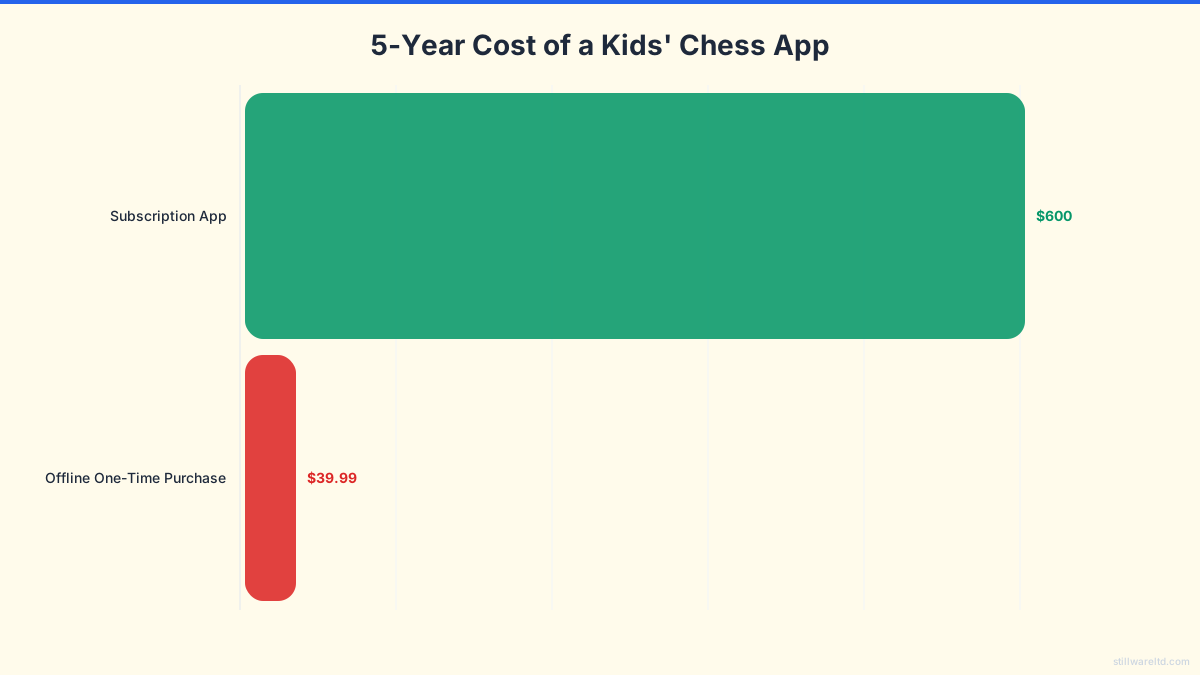
The math is stark. For the cost of two years of subscriptions, you could buy a premium physical chess set, several books, and a lifetime-licensed app. The subscription model works for the company’s recurring revenue; it rarely works for the family’s long-term budget.
An offline app with a one-time purchase flips this model. You pay once, typically at a fraction of a single year’s subscription cost, and own it forever. All future updates to the curriculum, puzzle sets, and engine are included. There are no renewal emails, no price hikes, and no risk of losing access because a credit card expired.
This isn’t just cheaper—it’s cognitively liberating. You’re not constantly evaluating if the monthly fee is “worth it” this month. The app is just there, a permanent part of your child’s digital toolkit, ready whenever the inspiration to play strikes, online or not.
Your Checklist for Choosing the Right Offline Chess App for Kids
Before you download anything, use this list to evaluate your options. If an app misses more than one of these points, keep looking.
- Works 100% Offline: Test it in airplane mode. Can you access all lessons, puzzles, and AI games?
- No Account Required: The app should open directly to a lesson or board. No login screen.
- Structured Learning Path: Look for a clear curriculum or chapter list, not just random activities.
- Substantial On-Device Content: Thousands of puzzles and multiple lesson hours should be included.
- Adjustable, Teaching AI: The computer should have named difficulty levels and offer game analysis.
- COPPA-Compliant Privacy Policy: It should explicitly state no data collection for users under 13.
- Clear, Upfront Pricing: A one-time purchase or a very long, fully-featured free trial. Beware of subscriptions.
- No Ads or In-App Purchases: The environment should be completely clean and focused.

The Road Ahead: Offline Learning as a Lifelong Skill
Choosing an offline chess app for kids does more than solve a logistical problem. It makes a statement about how you view technology and learning. It prioritizes depth over distraction, ownership over rental, and skill acquisition over passive engagement. The child learns that a device can be a library, a workshop, or a chess coach—not just a portal to the noisy internet.
The focus cultivated over a chessboard translates. The patience to think three moves ahead, the resilience to learn from a loss, the satisfaction of solving a complex puzzle—these are mental muscles strengthened in silence. An app that protects that silence is invaluable.
We built Rank Up Chess because every child deserves a world-class chess education that respects their privacy, their focus, and their family’s budget. It’s the app we wanted for our own families: comprehensive, permanent, and peaceful.
Ready to see how an offline-first approach can transform your child’s chess journey? Try Rank Up Chess—it’s a one-time purchase with a 34-day free trial, no subscription required. Give it a try and see the difference for yourself.
Try Rank Up Chess — Offline Chess Mastery for Kids
Try Rank Up Chess