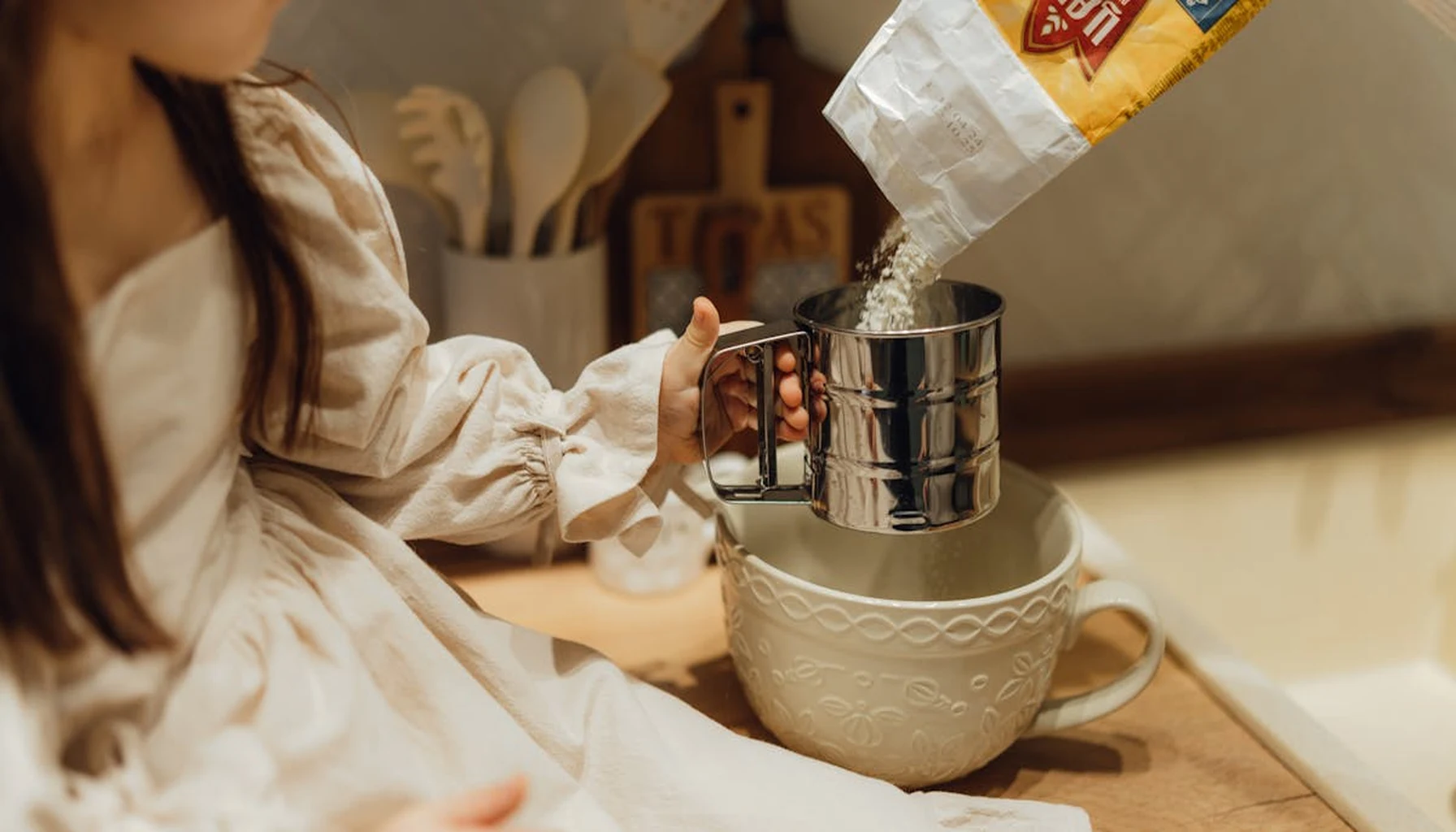
Why Cooking Beats Worksheets for Teaching Fractions
After reading this guide, you’ll be able to turn your kitchen into a math lab. You’ll have three specific, kid-tested recipes that make fractions tangible. More importantly, you’ll know how to teach kids fractions through cooking by guiding a child from seeing a half-cup as a mark on a measuring cup to understanding it as a relationship between numbers. The kitchen provides the only math classroom where the final exam is something you can eat.
This isn’t about adding screens to the process. It’s about using the physical tools already in your drawers—measuring cups, spoons, bowls—to demonstrate abstract concepts in a way that sticks. We’re moving math off the page and into their hands.
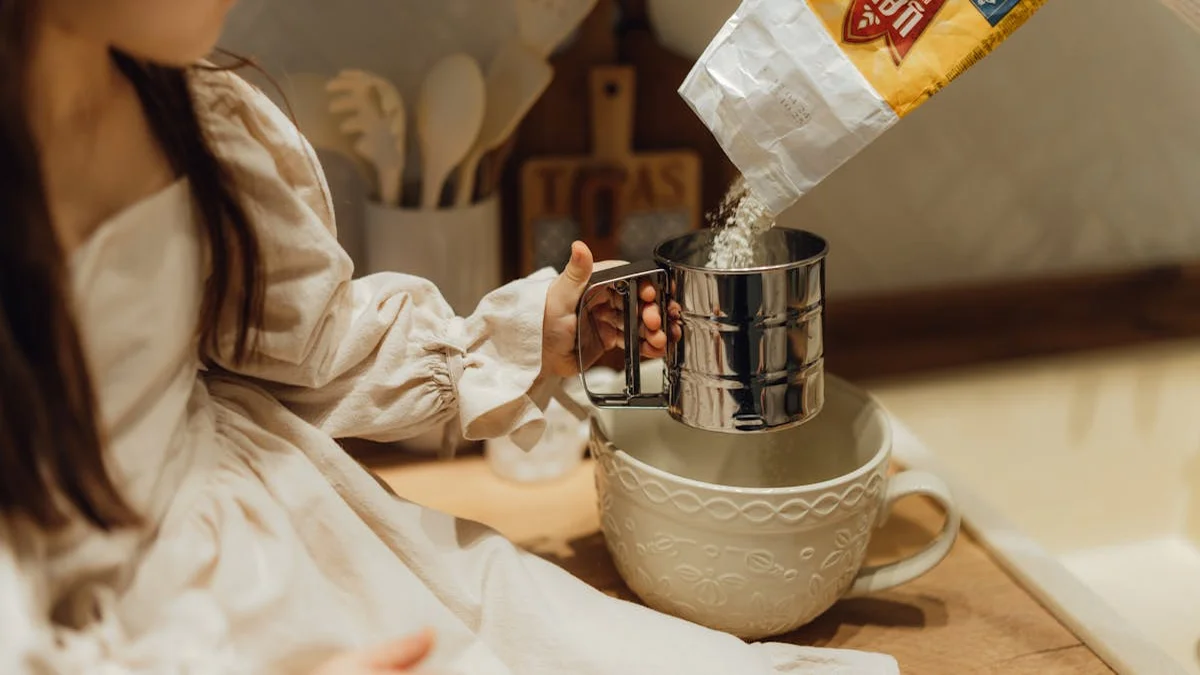
The Core Problem with Abstract Fraction Lessons
Most fraction lessons fail because they start with symbols on a page. A child is shown a circle split into three parts, with one part shaded, and told “this is 1/3.” The leap from that drawing to understanding what one-third of a cup of sugar means is enormous. The symbols have no connection to weight, volume, or outcome.
Worksheets test memorization, not comprehension. A child can shade in 3/4 of a rectangle but might not realize that three quarter-cups of water fill a measuring cup to the three-quarter line. The disconnect between the symbolic notation and the physical reality is where understanding breaks down.
After researching dozens of education apps, one pattern stands out: they often digitize the same abstract, symbolic approach. They replace the worksheet with a touchscreen, but the core problem remains. The learning is still divorced from a tangible, multisensory experience. It’s math in a vacuum.
The average elementary student spends over 120 hours a year on math instruction, yet foundational gaps in fraction understanding persist into high school. The system teaches calculation, not application.
How Cooking Makes Fractions Concrete (The Kitchen Math Method)
Cooking is a full-body, multisensory math lesson. A child doesn’t just see 1/2; they feel the weight of a half-cup of brown sugar, hear it being scooped, smell it in the dough, and taste it in the final cookie. The concept is embedded through every sense.
The kitchen naturally introduces every critical fraction operation:
- Addition: Two 1/4-cup scoops make 1/2 a cup.
- Subtraction: If the recipe needs 3/4 cup but you only have 1/2 cup, how much more do you need?
- Multiplication: Doubling a recipe means multiplying every ingredient by two.
- Division: Halving a recipe is dividing each amount by two.
The measuring cup is the ultimate visual aid, providing an immediate, physical proof of the mathematical relationship. When a child pours two 1/4 cups into a 1/2 cup measure and sees it fill exactly to the line, the equivalence ceases to be a theory. It becomes a law of the kitchen universe.
Your First Three “Math You Can Eat” Recipes
Start with these recipes. They are chosen for their high success rate, minimal fuss, and perfect fraction ratios. The goal is a delicious result, with math as the secret ingredient.
1. No-Bake Oatmeal Energy Bites (Focus: 1/2 and 1/4)
This is the perfect starter recipe. No oven, minimal mess, and it uses the most common fraction measurements.
Ingredients:
- 1 cup old-fashioned oats
- 1/2 cup peanut butter (or sunflower seed butter)
- 1/3 cup honey (a great chance to introduce the 1/3 cup measure!)
- 1/4 cup mini chocolate chips
- 1/4 cup ground flaxseed
- 1 teaspoon vanilla extract
The Math Lesson:
- Point out the 1/2 cup of peanut butter. Show how it fills the cup halfway.
- Have them measure the two 1/4 cup ingredients (chips and flax). Before adding, ask: “If we put these two together in a bigger cup, how much would we have?” Let them test their hypothesis by combining them in a 1/2 cup measure.
- The act of combining separate 1/4 portions into a single 1/2 cup provides an unforgettable visual for fraction addition.
2. Personal Pan Pizzas (Focus: Doubling & Thirds)
This lesson is about scaling. Make one personal pizza together, then double the recipe to make one for the whole family.
Single-Serve Dough:
- 1/2 cup all-purpose flour
- 1/4 teaspoon baking powder
- 1/8 teaspoon salt (show the tiny 1/8 spoon!)
- 2 tablespoons + 2 teaspoons water (this is 1/3 of a cup—another great visual)
- 1 teaspoon olive oil
The Math Lesson:
- Write down the single recipe. Then, work together to double it. “If we need 1/2 cup of flour for one, how much for two?” Guide them: 1/2 + 1/2 = 1 cup.
- Use the pizza itself. Cut it into halves, then fourths. “You ate 2/4 of the pizza. What’s another way to say that?” (1/2).
- Doubling a recipe forces a practical application of multiplication that has immediate, delicious consequences.
3. One-Bowl Muffins (Focus: Mixed Numbers & Wholes)
This recipe uses the classic “1-2-3” ratio, making it easy to remember and scale. It introduces the idea of a “whole” number of cups.
Basic Recipe:
- 1 cup mashed banana (about 2 bananas)
- 2 cups flour
- 3 teaspoons baking powder
- 1/2 cup milk
- 1/4 cup melted butter
- 1/3 cup sugar
The Math Lesson:
- Highlight the whole numbers: 1 cup, 2 cups. Ask: “How many 1/2 cups of milk would it take to make 1 whole cup?” Let them pour to find out.
- If you have a 1-cup measure with clear fraction markings, show how 1/2 + 1/4 + 1/4 fills the whole cup.
- This combines whole numbers with fractions, showing they are part of the same system, not separate concepts.

The Real Cost of Digital-Only Learning
Let’s talk about the hidden price of apps that require constant connectivity for “interactive” fraction games. It’s not just the monthly subscription fee, which can add up to $100 a year for a suite of educational apps. It’s the opportunity cost.
A subscription-based math app might provide digital worksheets and gamified quizzes. For your $9.99 a month, your child interacts with a screen. Compare that to a one-time investment in a set of measuring cups ($15) and the ingredients for a batch of cookies ($8).
The screen-based activity teaches compliance with the app. The kitchen activity teaches real skills:
- Fine motor skills (scooping, leveling, pouring).
- Sequential instruction following (the recipe).
- Real-world problem-solving (“We’re out of vanilla, what can we use?”).
- And most importantly, it builds a core memory where math is associated with creativity, warmth, and a tangible reward.
The financial math is simple. Over five years, a $10/month app subscription costs $600. The kitchen “lab” setup costs less than $50 once, and every lesson produces something of real, consumable value. The return on investment isn’t just academic; it’s literally on your plate.
Building a Focused Learning Environment
We believe the best learning happens with minimal distraction. Here’s why. The kitchen is a private space. It’s where mistakes are okay, where a child can spill flour without judgment, and where learning is messy and personal. That environment should be protected.
The philosophy for any learning aid should be experience-first. The thinking happens in the kitchen, and the evidence of learning is the muffin, not a progress report. This approach keeps the focus on the child’s understanding.
Your Step-by-Step Guide to a Fraction Cooking Lesson
Don’t wing it. A little structure turns cooking from a chaotic activity into a powerful lesson. Follow this framework.
- Choose the Recipe & Preview the Math: Before calling the kids in, look at the recipe. Identify 2-3 fraction concepts you’ll highlight (e.g., “Today we’re focusing on how two 1/4s make a 1/2”).
- Gather and Examine Tools: Lay out all the measuring cups and spoons. Have the child find the 1, 1/2, 1/3, and 1/4 marks on the cups. Compare sizes.
- Measure with Intent: For each ingredient, ask a guiding question. “This calls for 1/2 cup. Can you find the 1/2 line?” or “We need 1/4 teaspoon. How many of those would fit in this 1-teaspoon spoon?”
- Pause for Hypothesis: Before combining ingredients, ask predictive questions. “We’re adding 1/4 cup of oil and 1/2 cup of milk. How much liquid will that be in total?”
- Verify and Celebrate: Let them test their hypothesis by combining in a larger measure if possible. The moment of “I was right!” is powerful.
- Connect Back to Symbols: After cooking, while waiting for things to bake or set, draw the fractions you used. Connect the drawing to the physical cups they just held. This final step closes the loop, binding the physical experience to the abstract notation.
The process is more important than the product, though a good product certainly helps.
Moving Beyond the Recipe: Advanced Kitchen Math
Once the basic concepts are solid, introduce challenges that require real fraction fluency.
- The “Make It Healthier” Challenge: “This recipe has 1 cup of sugar. What if we only use 3/4 of that? How much is 3/4 of a cup?” Let them measure it out.
- The “Clean Out the Pantry” Challenge: “This recipe needs 1 cup of chocolate chips, but we only have a 1/3 cup left. Can we make a smaller batch? What would 1/3 of the recipe be?” This is advanced, but brilliant for older kids.
- The Estimation Game: Show them a 1/2 cup measure. Ask them to pour what they think is 1/4 cup of water into it, then check with the actual 1/4 cup measure. This builds intuitive number sense.
These activities teach adaptive thinking. Math isn’t about getting the right answer on a worksheet; it’s a tool for solving real-world problems, like adjusting dinner to what’s in the fridge.
“The kitchen is the only room in the house where you can use a math mistake to create something new. A little too much baking soda? You didn’t fail a test—you invented a new, crispier cookie.”
Ready to make math tangible? The next time your child faces a fraction worksheet, put it aside and pull out the mixing bowls. Start with the oatmeal bites. The understanding they’ll gain from seeing fractions in action will do more for their math confidence than a dozen digital drills. Give it a try this week—the proof, as they say, will be in the pudding.