YNAB Alternative With No Subscription: 2026 Ultimate Comparison
You just finished a long week. You sit down to review your finances, open your budgeting app, and see it: a notification for your annual subscription renewal. $99. Again. You pay it, because moving years of data feels impossible. You’re not renting a house or a car—you’re renting permission to access your own financial history. Finding a true YNAB alternative with no subscription is about ending that cycle of permission for good.
You want a tool you buy once, that respects your data as fiercely as you do, and works whether your internet is up or down. Let’s compare what’s out there, strip away the marketing, and look at what you actually get for your money—or your monthly fee.

The Real 5-Year Cost: Subscription Math Doesn’t Lie
The most persuasive argument for a subscription is that it funds continuous updates. The reality is simpler: it creates a predictable revenue stream for the company. For you, it creates a permanent financial leak.
Let’s run the numbers with a five-year horizon, a reasonable lifespan for a budgeting method you trust:
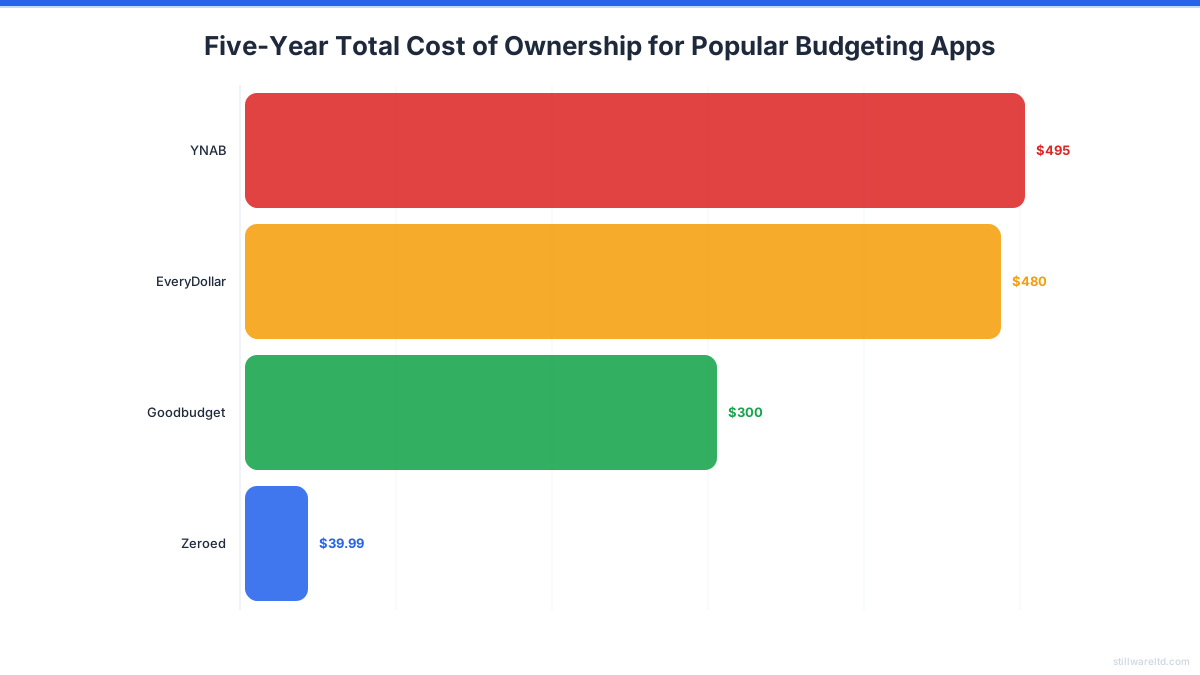
YNAB’s $99 annual fee totals $495 over five years. EveryDollar Plus, at $8/month, hits $480. Even Goodbudget’s “free” tier pushes you to its $7/month Plus plan, tallying $420. The subscription model quietly turns a simple tool into one of your more expensive software relationships.
When we built Zeroed, we benchmarked it against these alternatives. The math wasn’t close. A one-time purchase — $19.99 at the founder price until 14 February 2027, then $39.99 — isn’t just cheaper; it decouples the cost of the tool from the passage of time. Your investment is fixed.
The average user switching from a $99/year budgeting app to a one-time purchase saves over $450 in half a decade—enough to fully fund several budget categories.
The common counter-argument is that subscriptions ensure innovation. But look at the feature development cycles of major subscription apps. How often do they add genuinely transformative features versus incremental tweaks? The innovation you often pay for is in customer acquisition, not your user experience.
Architecture Showdown: Where Does Your Data Live?
This is the core divergence. Most budgeting apps, including YNAB, are cloud-first. Your transactions and financial history live on their servers. They use services like Plaid to connect to your bank, which means your banking credentials pass through a third-party system.
Local-first architecture, in contrast, treats your device as the primary vault. Here’s how the data flows differ:

Cloud-first proponents argue this is necessary for real-time sync. Local-first apps achieve the same thing differently. Zeroed, for example, uses your personal Google Drive as a sync medium. An encrypted database file lives in a folder you control. We literally cannot access your data. This isn’t a policy promise; it’s a technical impossibility given the architecture we chose.
The most common request we get is, “Can you add Plaid for auto-import?” We always say no. It’s not a technical limitation; it’s a philosophical line. Bringing a third-party service into the loop for convenience undermines the entire “zero-trust” premise. It reintroduces a server that can be breached.
2026 Feature-by-Feature Comparison
Let’s move past architecture and look at the day-to-day. What do you need a budgeting app to do, and how do the alternatives stack up?
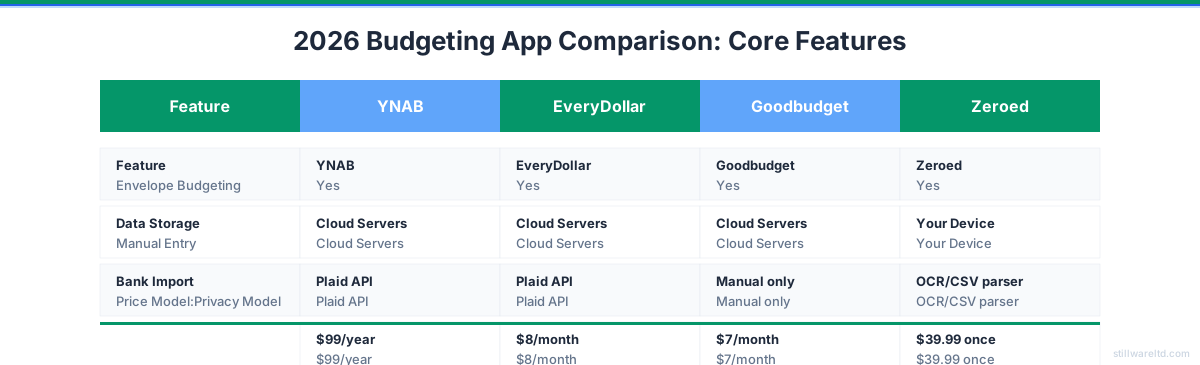
Envelope Budgeting: All four apps here are built on the zero-based envelope system. YNAB refined the methodology. The difference isn’t in the philosophy but in the execution.
Transaction Entry: This is the biggest workflow differentiator.
- YNAB/EveryDollar: Rely on Plaid auto-import. When it works, it’s seamless. When it fails, you’re left manually fixing imports.
- Goodbudget: Primarily manual entry, which is secure but can feel tedious.
- Zeroed: Uses a “universal parser” for CSVs and a powerful on-device OCR scanner for receipts. We built the OCR to work entirely offline because your receipt data shouldn’t need a round-trip to a cloud server just to read text.
Reporting & Visualization: YNAB offers robust web-based reports. Local-first apps like Zeroed generate all visualizations directly on your device. The graphs might be simpler, but they contain every byte of your private data, never transmitted.
Cross-Device Sync: YNAB syncs via its cloud. Zeroed syncs via your encrypted file on Google Drive. The end-user experience is similar. The architectural middleman is just different. One is a company server, the other is a storage locker you control. For more on how this encryption works, see our deep dive on how Zeroed encrypts your data without a server.
The Offline-First Advantage: It’s Not Just About Privacy
Privacy is the headline, but the practical benefits of an offline-first app play out daily. Your financial awareness shouldn’t be held hostage by your Wi-Fi signal.
Think about these scenarios:
- On a flight: Log a duty-free purchase. No problem.
- During an internet outage: Your power is out, but your phone has battery. You can still check your grocery budget.
- At a bank appointment: Reference your savings rate history instantly—no guest Wi-Fi needed.
This resilience is a feature. Local processing means the app is often faster, as it’s not waiting for network latency to validate a transaction or redraw a chart. It uses the powerful processor already in your pocket.
4 Common Mistakes When Switching from YNAB
If you’re migrating from a subscription service, you’re changing a mindset. Avoid these pitfalls:
- Expecting a 1:1 Feature Clone: No two apps are identical. Focus on the core job: allocating funds, tracking spending, and planning ahead.
- Underestimating Manual Workflow: Moving away from Plaid means more hands-on transaction entry. This isn’t a drawback; it’s intentional engagement. The 60 seconds you spend scanning a receipt forces you to acknowledge the spending.
- Neglecting Initial Setup: The most work happens at the start. Export your data from YNAB, map your categories, and set up your budget. This half-day of effort pays off for years.
- Forgetting Sync Setup: With a cloud app, sync is magic. With a local-first app, you need to connect to your Drive account on all devices. It’s a one-time, five-minute setup per device, but it’s a step you control.
Why a “One-Time Purchase” Model Actually Works
You might wonder how a company can survive without recurring revenue. It’s a fair question. The model works through clarity and scale.
We sell a finished tool, not a continuous service. Development costs are factored into the initial price. There are no server costs for user data and no customer service overhead for bank connection issues. This allows a sustainable business at a much lower price point.
Future updates are funded by new customers buying the tool, not by existing users renting it. This aligns our incentives perfectly: to make the app so good that new people find it and recommend it.
Furthermore, when you buy a lifetime license, you own that version forever. If development stopped, the app on your device would continue to function indefinitely. Your financial system wouldn’t vanish because a company decided to pivot—a real risk with any subscription service. For a detailed breakdown of subscription costs, read our analysis of the true cost of YNAB over 5 years.
Making the Choice: Your 2026 YNAB Alternative No Subscription Guide
This isn’t about declaring one app the universal winner. It’s about matching a tool to your priorities. Ask yourself these questions:
- Is automatic bank import non-negotiable? If yes, you’re in subscription territory. Accept the cost and the data model that comes with it.
- Is data privacy and ownership your top concern? A local-first, one-time purchase app is your only real option.
- Do you budget in places with spotty internet? Offline capability transitions from a nice-to-have to a core requirement.
- Are you tired of monthly fees? Calculate the 5-year TCO. The savings from a one-time purchase are stark.
The 2026 landscape shows a clear divide. On one side, polished, cloud-dependent ecosystems with recurring fees. On the other, focused, private tools you own outright. The former offers convenience at the cost of perpetual payment. The latter requires more engagement but returns full ownership, privacy, and a fixed cost.
The shift to a YNAB alternative with no subscription is a vote for a different relationship with your software. It’s the choice to be an owner in your own financial life.
Ready to stop renting your budget? Discover how a one-time purchase can work. Learn more about why we don’t do subscriptions or try Zeroed with a full 34-day free trial—no subscription, no credit card required. See if a one-time purchase and local-first control fit your financial workflow.
Try Zeroed Free — One-Time Purchase, No Subscription
Try Zeroed Free