What You’ll Understand After Reading This
You’ll be able to spot the architectural difference between software you rent and software you own. You’ll know why an app that works on a plane is fundamentally different from one that needs Wi-Fi. And you’ll see why the local-first software movement isn’t about adding a feature—it’s about redefining who controls the bits and bytes of your digital life.
The Core Idea: Your Device Is the Server
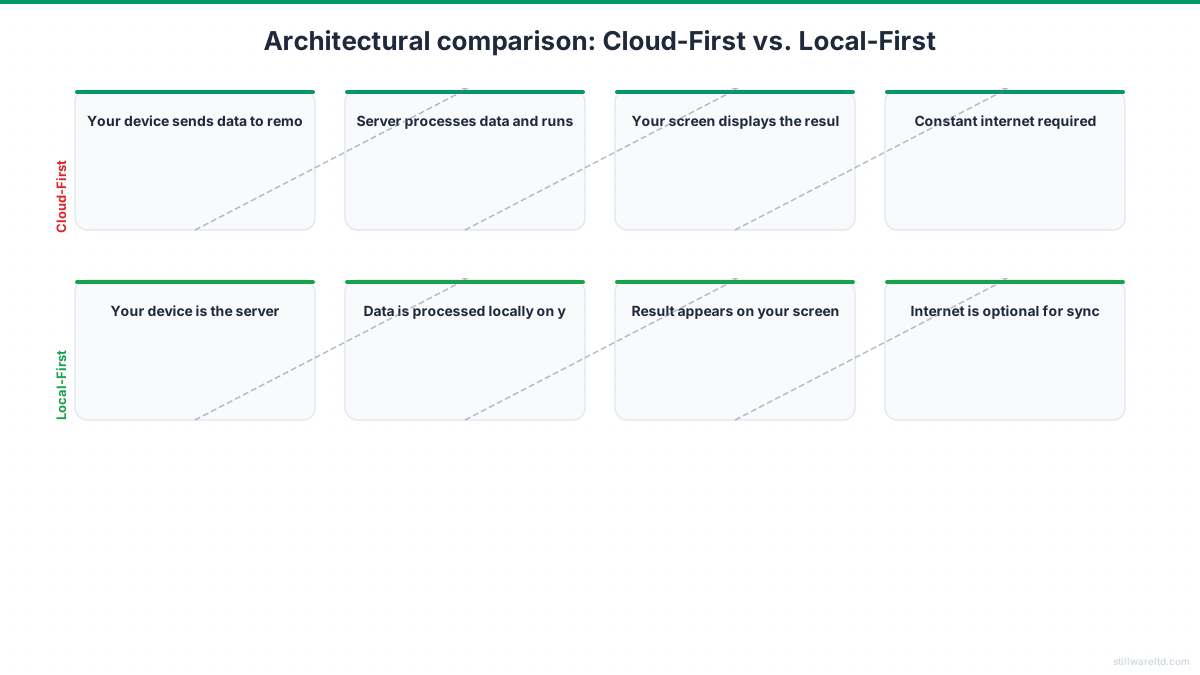
Cloud-first design assumes your phone or computer is a dumb terminal. It’s a viewport into an application that lives on a company’s server. Your data, your logic, your entire experience is piped through their infrastructure. The app icon on your home screen is just a doorway.
Local-first flips that model. The primary copy of your data, and the software that processes it, lives on the device in your hand. Your phone isn’t a terminal; it’s the mainframe. This isn’t just a technical detail—it changes everything about privacy, cost, longevity, and capability.
When we built Zeroed, we tested it against subscription-based budgeting tools. The most glaring difference wasn’t the price tag; it was the latency. Opening a cloud app meant waiting for a server handshake, even to see your own budget from yesterday. A local-first app like Zeroed loads your financial history instantly because it’s not asking for permission from a data center in Oregon.
The Practical Test: Does It Work on a Plane?
This is the simplest litmus test for local-first software. Can you open the app at 30,000 feet, in airplane mode, and do meaningful work?
For a budgeting app, that means:
- Reviewing your remaining grocery budget.
- Logging a coffee you just bought at the airport.
- Scanning a receipt with your phone’s camera.
- Adjusting next month’s plan.
If the app stutters, demands a “reconnection,” or shows blank screens, it’s cloud-first. Its value proposition depends on a persistent, silent conversation with a server you don’t control. A local-first app treats the internet as a useful optional feature—like a backup tool—not as its life support system.
The most common request we get for Zeroed is for automatic bank syncing via services like Plaid. We say no every time. It’s not a technical limitation; it’s a philosophical line. Once you tether your app to a third-party API that requires cloud authentication, you’ve moved the locus of control. You’re no longer local-first. You’ve built a cloud conduit into the heart of the app.
The Ownership Spectrum: Tenant vs. Owner
Think about the software you use daily. Where do you fall on this spectrum?
| Cloud-First (You are a Tenant) | Local-First (You are the Owner) | |
|---|---|---|
| Data Location | Company servers. You access it. | Your device. You possess it. |
| Primary Access | Requires your password and their server’s health. | Requires your device (or your own encrypted backup). |
| Cost Model | Subscription (rent). Stops working if you stop paying. | One-time purchase (asset). Works forever after one payment. |
| Offline Capability | Limited or none. Core features often disabled. | Full. The app is designed to operate independently. |
| Long-Term Risk | Company can change terms, increase price, or shut down. | You retain a working copy. The company can vanish, and your tool remains. |
Being a tenant is convenient until the landlord changes the locks. The local-first software movement argues that for personal, critical data—your finances, your journals, your creative work—you shouldn’t be a tenant. Owning your software means its utility isn’t contingent on a distant company’s business model or survival.
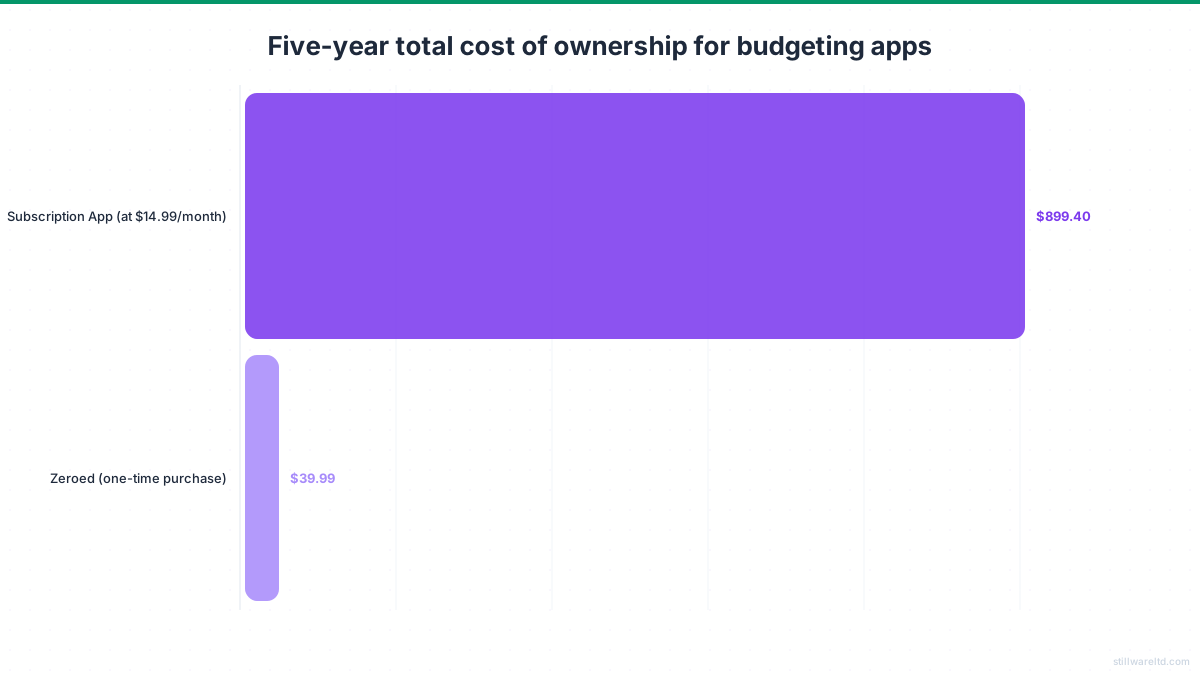
We benchmarked Zeroed against popular subscription alternatives. The five-year cost difference isn’t a small discount; it’s the difference between paying over $500 to rent access to your own financial data versus a single one-time payment — $19.99 at the founder price until 14 February 2027, then $39.99 — to own the tool outright. The math makes the philosophy concrete.
A Worked Example: The Local-First Budget
Let’s follow a transaction in a local-first system like Zeroed, versus a cloud-first system.
- The Purchase: You buy a book for $24.99.
- In a Cloud-First App: You open the app. It checks for an internet connection. It authenticates your session with a server. You enter the transaction. The data is sent to the cloud, processed, and the updated “Books” envelope balance is sent back to your phone. If the server is slow or down, you wait, or the entry fails.
- In a Local-First App: You open the app. It instantly shows your current envelope balances. You enter “$24.99” and categorize it as “Books.” The balance updates immediately, calculated on your device’s processor. The new transaction is saved to your phone’s encrypted storage. Later, if you choose, the app can silently back up the encrypted data file to a folder in your personal Google Drive.
The second flow isn’t just faster; it’s more resilient. It works in a basement, on a subway, or during an internet outage. The speed and reliability aren’t optimizations; they are direct consequences of the local-first architecture.
Why This Movement is Growing Now
For decades, the default answer to any software problem was “add a server.” It centralized control, made updates easier for developers, and created lucrative subscription pipelines. But the downsides are now in plain sight: data breaches, vendor lock-in, feature bloat, and the quiet creep of surveillance for “product insights.”
The local-first movement is a correction. It asks a simple question: does this task need a server? For an alarming number of personal productivity apps—budgeting, note-taking, photo editing, document writing—the answer is no. Your smartphone has more processing power than the computers that sent men to the moon. It doesn’t need to beg a remote server to add two numbers.
The average user spends hundreds per year renting software that their device is already powerful enough to run independently.
This isn’t about rejecting the cloud entirely. It’s about demoting it from master to servant. In Zeroed, your Google Drive acts as a dumb, encrypted filing cabinet you control—not as the brain of the operation. You hold the encryption keys. We just provide the wallet.
The Trade-Offs (Because Nothing is Free)
Local-first isn’t a magic bullet. It comes with real trade-offs that its proponents acknowledge.
- No Real-Time Collaboration: You can’t have a Google Docs-style live-editing session with a local-first word processor. Sync becomes a deliberate “merge” action, not a continuous stream.
- Developer Responsibility: Security is paramount. If the app’s local encryption is flawed, the user’s data is directly exposed. There’s no server as a buffer.
- Setup Complexity: Using your own Google Drive for sync requires a one-time setup, which is more steps than just signing in with Google on a cloud app.
These aren’t weaknesses to be hidden; they are design constraints that shape honest software. The local-first movement embraces these constraints because they flow from the core principle: user sovereignty over convenience. It chooses a model where you might have to think about your backups, in exchange for never having to worry about your data being mined or your access being revoked.
Your Next Step
The local-first software movement is more than a technical trend; it’s a quiet rebellion against the assumption that we must trade ownership for convenience. It proves that powerful, private, and permanent software can still exist.
This philosophy is why we build apps the way we do. Full disclosure: we built Zeroed as a direct application of these principles—a hardcore, manual-entry budgeting app that works because your device is powerful enough, not because our servers are.
Ready to experience the difference? The best way to understand local-first is to use it. Try Zeroed free for 34 days—a fully offline, one-time purchase app that puts you back in control. See for yourself what it means to own your tools, not just rent them.
Try Zeroed — the local-first budgeting app
Try ZeroedWant to go deeper? Explore our guide to the best budgeting apps without a subscription or see how a budgeting app that works without internet handles real-world scenarios.